
Plant Nutrition & Fertilizers
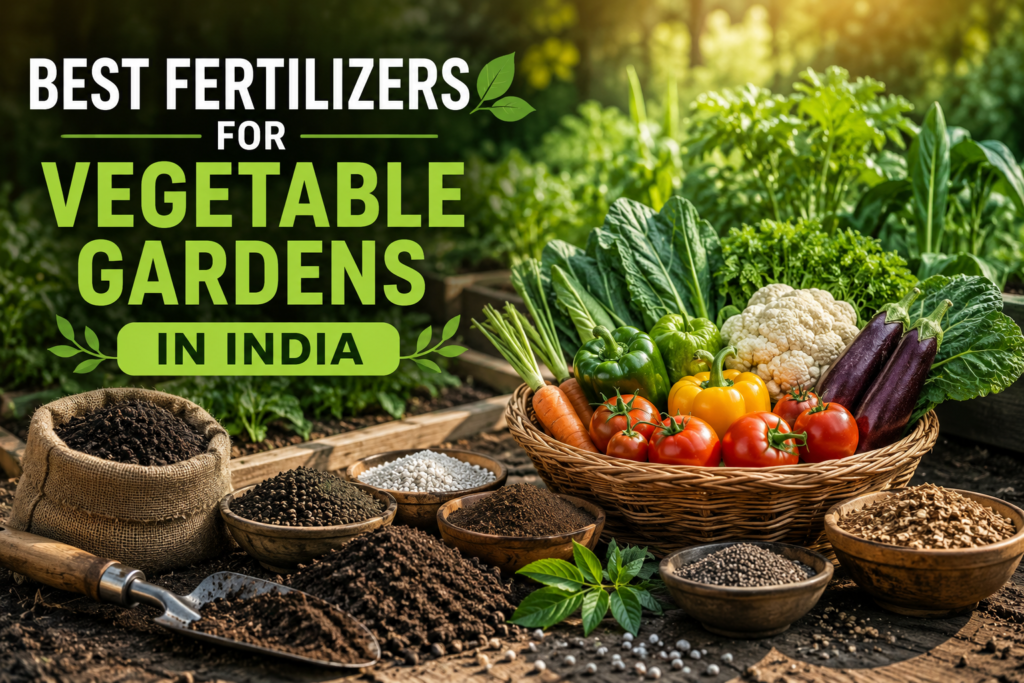
Best Fertilizers for Vegetable Gardens in India
03
Jul
Jul
Quick Summary
- Compost or vermicompost should be the foundation of every vegetable garden.
- Neem cake improves soil health while reducing certain soil pests.
- Balanced NPK fertilizers support rapid vegetable growth.
- Seaweed extract helps plants recover from stress.
- Bone meal is useful for root crops and flowering vegetables.
- Micronutrients prevent hidden nutrient deficiencies.
- Different vegetables require different nutrient levels.
- Avoid over-fertilizing as it often reduces yields instead of improving them.
Why Fertilizers Matter
Short answer: Fertilizers replace nutrients removed from the soil and help vegetables grow vigorously, produce more flowers, and yield healthier harvests. Vegetable crops are heavy feeders because they produce leaves, stems, flowers, and fruits within a relatively short period. Every harvest removes nutrients from the soil. Without replenishment, soil fertility gradually declines, resulting in slow growth, pale foliage, poor flowering, and reduced production. Good fertilizers do more than supply nutrients. They also improve root development, support beneficial soil microorganisms, enhance water retention when organic matter is used, and increase the plant’s ability to tolerate heat and drought.Types of Fertilizers Used in Indian Vegetable Gardens
Short answer: Vegetable gardeners generally use organic fertilizers, inorganic fertilizers, or a combination of both.Organic Fertilizers
Organic fertilizers are derived from natural materials and improve both soil fertility and soil structure over time.- Compost
- Vermicompost
- Farmyard manure
- Neem cake
- Bone meal
- Mustard cake
- Seaweed extract
- Fish emulsion
- Improve soil structure
- Increase microbial activity
- Release nutrients gradually
- Reduce nutrient leaching
- Suitable for long-term soil health
Inorganic (Chemical) Fertilizers
These fertilizers supply nutrients in concentrated, readily available forms.- Urea
- DAP
- MOP (Muriate of Potash)
- NPK 19:19:19
- NPK 20:20:20
- NPK 10:26:26
- Calcium nitrate
- Magnesium sulfate (Epsom salt)
- Fast nutrient availability
- Easy to measure
- Useful for correcting deficiencies
- Supports rapid vegetative growth
Comparison of Popular Fertilizers
Short answer: No single fertilizer is best for every situation. Each serves a different purpose.| Fertilizer | Main Benefit | Best For | Speed |
|---|---|---|---|
| Compost | Improves soil health | All vegetables | Slow |
| Vermicompost | Balanced nutrition | Leafy vegetables | Medium |
| Neem Cake | Soil improvement | Root development | Slow |
| Seaweed Extract | Stress recovery | All crops | Fast |
| Bone Meal | Phosphorus supply | Root vegetables | Slow |
| NPK 19-19-19 | Balanced nutrition | General vegetables | Fast |
| Calcium Nitrate | Calcium supply | Tomato, chilli | Fast |
| Epsom Salt | Magnesium | Correct deficiency | Fast |
Best Fertilizers for Vegetable Gardens in India
Short answer: A combination of soil-building organic fertilizers and targeted nutrient supplements generally produces the healthiest vegetable gardens.1. Compost
Compost remains the most valuable fertilizer for home vegetable gardens because it feeds both the plants and the soil. Regular compost application improves soil texture, increases moisture retention, and encourages beneficial microorganisms that help make nutrients available to roots. Best for: Every vegetable crop. Works especially well with: Tomatoes, spinach, brinjal, cabbage, cauliflower, beans, okra, cucumbers, gourds, and leafy greens.2. Vermicompost
Vermicompost is produced by earthworms and contains readily available nutrients along with beneficial microbes. It is gentle on young plants and particularly effective in kitchen gardens and container gardening. Benefits- Improves seedling establishment
- Encourages healthy root growth
- Enhances microbial activity
- Provides balanced nutrition
3. Neem Cake
Neem cake is both a soil conditioner and an organic nutrient source. Besides supplying nutrients, it slows nitrogen loss and supports healthier root zones. It is commonly incorporated into soil before planting and during bed preparation. Ideal for:- Tomatoes
- Brinjal
- Chilli
- Okra
- Cucumber
- Bottle gourd
4. Seaweed Extract
Seaweed extract is not a replacement for primary fertilizers but acts as an effective plant biostimulant. It contains naturally occurring compounds that encourage root growth, improve nutrient uptake, and help plants recover from environmental stress such as heat or transplant shock. Use when:- Transplanting seedlings
- High summer temperatures
- Flower initiation
- Plants appear stressed
5. Balanced NPK Fertilizer
Balanced NPK fertilizers supply nitrogen (N), phosphorus (P), and potassium (K) in equal or near-equal proportions. They are useful when vegetables require steady growth and the soil lacks sufficient available nutrients. Water-soluble formulations are commonly used for:- Tomato
- Capsicum
- Chilli
- Cucumber
- Beans
- Brinjal
How to Choose the Best Fertilizer for Vegetables
Short answer: Match the fertilizer to your soil condition, crop type, and stage of plant growth instead of choosing based on popularity alone. Consider the following factors before selecting a fertilizer:- Soil condition: Sandy soils lose nutrients faster and benefit from frequent additions of compost and organic matter, while clay soils retain nutrients longer but may require better drainage.
- Vegetable type: Leafy greens generally require more nitrogen, whereas fruiting vegetables such as tomatoes and peppers need balanced nutrition with adequate phosphorus and potassium during flowering and fruit development.
- Growth stage: Young seedlings need gentle nutrition, actively growing plants benefit from balanced feeding, and flowering plants often require increased potassium support.
- Garden type: Containers lose nutrients more quickly than in-ground beds, so regular but lighter applications are usually more effective.
- Climate: Heavy rainfall can wash away nutrients, while prolonged heat may reduce nutrient uptake. Adjust feeding schedules based on seasonal conditions.
Organic Fertilizer for Vegetables vs Chemical Fertilizers
Short answer: Neither is universally better. Organic fertilizers build long-term soil health, while chemical fertilizers provide nutrients quickly. For most Indian home vegetable gardens, using both strategically often gives the best results.| Feature | Organic Fertilizers | Chemical Fertilizers |
|---|---|---|
| Nutrient release | Slow and gradual | Fast and immediate |
| Improves soil structure | Yes | No |
| Supports soil microbes | Excellent | Minimal |
| Risk of overfeeding | Low | Higher if misused |
| Long-term soil health | Excellent | Depends on management |
| Cost per application | Usually higher volume required | Lower quantity required |
| Visible plant response | Gradual | Usually faster |
Understanding NPK for Vegetable Plants
Short answer: Nitrogen grows leaves, phosphorus develops roots and flowers, and potassium improves fruit quality, disease resistance, and overall plant health.| Nutrient | Main Function | Deficiency Symptoms | Excess Problems |
|---|---|---|---|
| Nitrogen (N) | Leaf and stem growth | Pale green or yellow older leaves | Too many leaves, fewer fruits |
| Phosphorus (P) | Roots, flowering, energy transfer | Poor root growth, delayed flowering | Can reduce micronutrient availability |
| Potassium (K) | Fruit quality, stress tolerance | Brown leaf edges, weak plants | May interfere with magnesium uptake |
Recommended Fertilizer Schedule for Home Vegetable Gardens
Short answer: Feed the soil before planting, support vegetative growth after establishment, and adjust nutrients during flowering and fruiting.| Growth Stage | Recommended Fertilizers | Purpose |
|---|---|---|
| Before Planting | Compost + Vermicompost + Neem Cake | Prepare fertile soil |
| 2–3 Weeks After Planting | Balanced NPK or Vermicompost | Encourage vegetative growth |
| Flower Formation | Seaweed Extract + Balanced Fertilizer | Support flowering |
| Fruit Development | Potassium-rich nutrition if needed | Improve fruit size and quality |
| Harvest Period | Light compost top dressing | Maintain soil fertility |
Best Fertilizers for Popular Vegetables
Short answer: Different vegetables have different nutrient requirements. Matching fertilizer to crop improves productivity and reduces waste.| Vegetable | Recommended Fertilizers | Focus |
|---|---|---|
| Tomato | Compost, Neem Cake, Balanced NPK, Calcium | Flowering and fruit quality |
| Chilli | Compost, Vermicompost, Seaweed | Continuous flowering |
| Brinjal | Compost, Balanced NPK | Fruit production |
| Spinach | Compost, Vermicompost | Leaf growth |
| Coriander | Compost | Healthy foliage |
| Cabbage | Compost, Nitrogen-rich feeding | Leaf formation |
| Cauliflower | Balanced nutrition with calcium | Head development |
| Okra | Neem Cake, Compost, Balanced NPK | Steady production |
| Cucumber | Compost, Seaweed, Balanced NPK | Flowering and fruiting |
| Beans | Compost with moderate feeding | Healthy pods |
Best Fertilizer for Vegetables in Pots and Containers
Short answer: Container-grown vegetables require more frequent but lighter feeding because nutrients are depleted and washed out faster than in garden soil. For balcony gardens and terrace gardens:- Mix compost into the potting mix before planting.
- Top dress with vermicompost every few weeks during active growth.
- Use water-soluble fertilizers only at recommended concentrations.
- Water thoroughly after fertilizer application.
- Replace or refresh part of the growing media after each crop cycle.
Best Fertilizer Strategy for Raised Beds
Short answer: Raised beds benefit from regular additions of organic matter because intensive planting removes nutrients quickly. Each growing season:- Add mature compost before planting.
- Incorporate neem cake during bed preparation.
- Mulch to conserve moisture and reduce nutrient loss.
- Feed heavy-feeding vegetables separately when necessary.
- Rotate crops to reduce nutrient depletion.
Micronutrients: The Often Overlooked Part of Plant Nutrition
Short answer: Even when nitrogen, phosphorus, and potassium are sufficient, vegetables may perform poorly if micronutrients are lacking.| Micronutrient | Role | Possible Deficiency Symptoms |
|---|---|---|
| Calcium | Cell wall development | Blossom end rot in tomatoes |
| Magnesium | Chlorophyll production | Yellowing between leaf veins |
| Iron | Leaf greening | Yellow young leaves |
| Zinc | Growth regulation | Small leaves and slow growth |
| Boron | Flower and fruit development | Poor fruit set |
Best Fertilizers for Vegetable Gardens in India: Buying Tips
Short answer: Feed the soil consistently, monitor plant growth, and apply fertilizers only when needed.- Start with healthy, organic-rich soil.
- Use well-decomposed compost.
- Water before and after applying concentrated fertilizers when appropriate.
- Apply fertilizers during cooler parts of the day.
- Avoid placing concentrated fertilizers directly against stems or roots.
- Observe plants regularly for nutrient deficiency or excess.
- Rotate crops to maintain soil fertility.
- Mulch to reduce nutrient loss and improve moisture retention.
Common Fertilizer Mistakes to Avoid
Short answer: Most fertilizer problems result from applying too much, too often, or without understanding what the plant actually needs.- Applying excessive nitrogen to fruiting vegetables.
- Using fresh manure instead of well-composted manure.
- Ignoring soil quality.
- Applying fertilizers to dry soil without adequate watering where required.
- Using the same fertilizer for every crop and every growth stage.
- Assuming yellow leaves always indicate nitrogen deficiency.
- Mixing incompatible products without checking label instructions.
- Increasing fertilizer dosage after poor growth without identifying the actual cause.
Seasonal Fertilizer Guide for Indian Vegetable Gardens
Short answer: Fertilizer requirements change throughout the year because temperature, rainfall, and crop selection influence nutrient uptake.| Season | Common Vegetables | Recommended Fertilizers |
|---|---|---|
| Summer | Tomato, Chilli, Okra, Cucumber | Compost, Neem Cake, Seaweed Extract, Balanced NPK |
| Monsoon | Beans, Gourds, Spinach | Compost, Vermicompost, Light NPK applications |
| Winter | Cabbage, Cauliflower, Peas, Carrot, Beetroot | Compost, Bone Meal, Balanced NPK |
Recommended Fertilizers for Home Vegetable Gardens
Short answer: The following fertilizers support healthy soil, stronger roots, balanced plant growth, flowering, fruit development, and improved vegetable yields. Choose products based on your crop’s growth stage rather than using every fertilizer at once.| GreenKheti Product | Best For | Use Stage | Main Benefit | Buy Now |
|---|---|---|---|---|
| Neem Cake Powder | Soil preparation | Before planting | Improves soil health and root development | GreenKheti Amazon |
| MycoMagic Mycorrhiza | Root establishment | Planting & Transplanting | Supports stronger root systems and nutrient uptake | GreenKheti Amazon |
| Humic Acid 98% | Weak plants | Vegetative stage | Improves nutrient availability and root growth | GreenKheti Amazon |
| Seaweed Extract | Heat & transplant stress | Throughout growth | Supports flowering, nutrient uptake and stress tolerance | GreenKheti Amazon |
| Epsom Salt | Magnesium deficiency | As required | Supports greener foliage and chlorophyll production | GreenKheti Amazon |
| NutriK Potash Meal | Flowering & fruit development | Flowering stage | Provides organic potassium for better fruit quality | GreenKheti Amazon |
| Power Meal Bone Meal | Root crops & flowering vegetables | Before planting | Provides phosphorus and calcium for healthy root development | GreenKheti Amazon |
Why We Recommend These Products
Each fertilizer has a different role in vegetable gardening. Organic soil conditioners such as neem cake improve long-term soil health, mycorrhiza enhances root growth, humic acid improves nutrient availability, seaweed extract supports plant recovery from stress, while potassium and bone meal help improve flowering, fruit development, and root strength. Select fertilizers according to your crop’s growth stage and always follow the recommended application rates.Frequently Asked Questions
Which is the best fertilizer for vegetable gardens in India?
A combination of compost, vermicompost, neem cake, and a balanced NPK fertilizer provides reliable nutrition for most home vegetable gardens.Is compost alone enough for vegetables?
Compost is an excellent foundation, but heavy-feeding vegetables such as tomatoes, cabbage, and cauliflower often benefit from additional nutrients during active growth.Can I use only organic fertilizers?
Yes. Many home gardeners successfully grow vegetables using compost, vermicompost, oilseed cakes, seaweed extract, and other organic inputs. Results depend on soil quality, crop type, and proper nutrient management.How often should vegetables be fertilized?
There is no single schedule for every garden. Fast-growing vegetables generally require more frequent feeding than slow-growing crops. Always follow product recommendations and observe plant growth.Which fertilizer is best for tomatoes?
Tomatoes perform well with compost before planting, balanced NPK during growth, calcium when needed, and seaweed extract to reduce transplant and heat stress.Is neem cake a fertilizer or a pesticide?
Neem cake is primarily an organic soil amendment and nutrient source. It also helps improve soil health and may reduce certain soil-borne pest problems when used as part of an integrated gardening approach.Can too much fertilizer damage plants?
Yes. Over-fertilizing may cause root burn, excessive leafy growth, delayed flowering, nutrient imbalance, and reduced yields.Should fertilizers be applied before watering or after watering?
This depends on the product. Granular fertilizers are often applied to moist soil followed by watering, while water-soluble fertilizers are mixed with irrigation water according to label directions.Do vegetables grown in pots need more fertilizer?
Yes. Nutrients are depleted more quickly in containers because of limited growing media and regular watering.What is the difference between compost and vermicompost?
Compost is produced through natural decomposition of organic materials, while vermicompost is processed by earthworms. Vermicompost generally contains more readily available nutrients and beneficial microorganisms.Is seaweed extract a complete fertilizer?
No. Seaweed extract is a biostimulant that supports plant growth and stress tolerance but does not replace complete fertilizers supplying sufficient nitrogen, phosphorus, and potassium.Should I perform a soil test?
If possible, yes. A soil test provides valuable information about nutrient availability and pH, helping you choose fertilizers more accurately and avoid unnecessary applications.Conclusion
The best fertilizer for a vegetable garden in India is rarely a single product. Healthy gardens are built through a combination of fertile soil, balanced nutrition, proper watering, and good gardening practices. For most home gardeners, begin with generous amounts of compost or vermicompost, improve soil with neem cake, and supplement with balanced fertilizers only when crops require additional nutrients. Seaweed extract and micronutrients can provide valuable support during transplanting, flowering, or periods of environmental stress. Rather than feeding plants excessively, focus on building healthy soil. Strong soil supports stronger roots, healthier vegetables, improved resilience, and more consistent harvests season after season.