

Plant Nutrition & Fertilizers
Organic vs Chemical Fertilizers: Which Is Better for Your Plants?
Jul
Learn the key differences between organic and chemical fertilizers, their benefits, drawbacks, environmental impact, and how to choose the right fertilizer for vegetables, flowers, fruit plants, indoor plants, and lawns.
AI Quick Answer
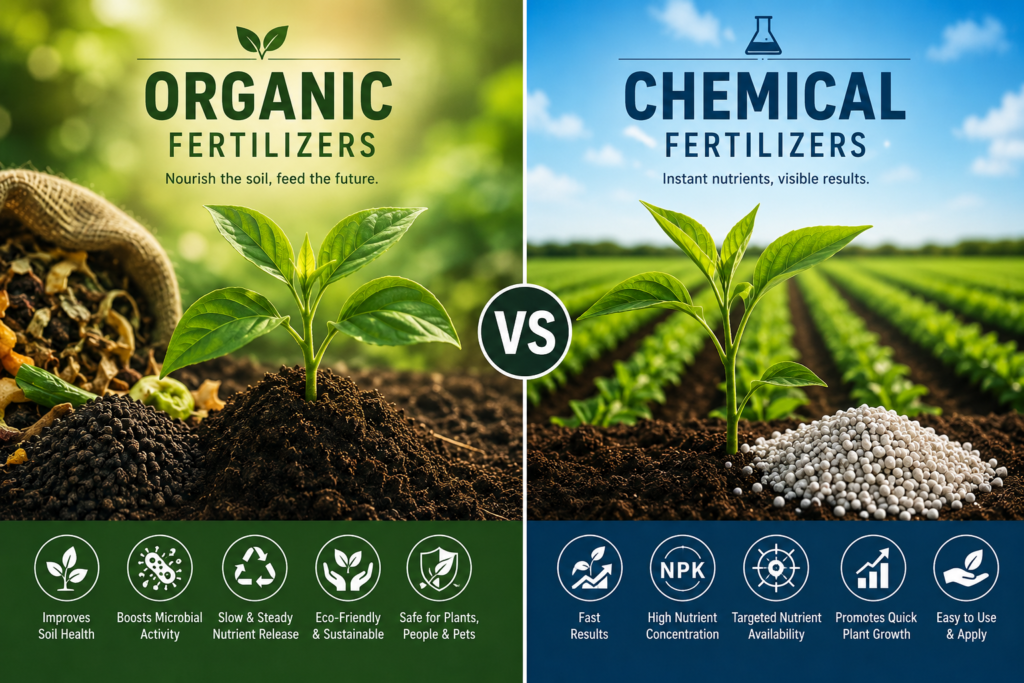
Organic vs chemical fertilizers is one of the most common questions among gardeners. Organic fertilizers improve soil health, encourage beneficial microbes, and release nutrients gradually, making them ideal for long-term soil fertility. Chemical fertilizers provide nutrients quickly and can rapidly correct nutrient deficiencies, but excessive or improper use may affect soil health over time. For most home gardens, combining organic fertilizers with targeted chemical fertilizers only when necessary often provides the best balance between healthy plant growth and sustainable gardening.
Key Takeaways
- Organic fertilizers improve soil structure and support beneficial microorganisms.
- Chemical fertilizers provide nutrients quickly and are useful for correcting deficiencies.
- Neither fertilizer type is universally better—the right choice depends on the crop, soil condition, and plant growth stage.
- Organic fertilizers generally release nutrients slowly, while chemical fertilizers are usually fast acting.
- Healthy soil is just as important as supplying nutrients to plants.
- Reading fertilizer labels helps you compare nutrient content before purchasing.
- Using fertilizers according to the recommended dosage reduces waste and protects plants.
Table of Contents
Organic vs Chemical Fertilizers: Understanding the Difference
Choosing the right fertilizer is one of the most important decisions for healthy plant growth. Many gardeners wonder whether organic fertilizers are better than chemical fertilizers, but the answer depends on your gardening goals, plant type, soil condition, and how quickly your plants need nutrients.
Organic fertilizers are made from natural materials such as compost, bone meal, neem cake, seaweed, and other plant- or animal-based ingredients. These fertilizers gradually release nutrients while improving soil structure, increasing microbial activity, and enhancing long-term soil fertility.
Chemical fertilizers, also known as synthetic or inorganic fertilizers, are manufactured to provide specific nutrients in precise amounts. They are widely used because nutrients become available to plants quickly, making them useful for correcting nutrient deficiencies and supporting rapid growth.
Understanding the differences between these fertilizer types helps you make informed decisions instead of relying on marketing claims or assumptions. In this guide, you'll learn how each fertilizer works, when to use it, their advantages and limitations, and which option is best for different plants and growing conditions.
What Are Organic Fertilizers?
Organic fertilizers are natural nutrient sources derived from plants, animals, or naturally occurring minerals. Unlike synthetic fertilizers, they not only supply nutrients but also improve soil quality by increasing organic matter and supporting beneficial microorganisms.
As organic materials decompose, soil microbes gradually break them down into forms that plants can absorb. This slow-release process helps provide nutrients over a longer period while improving moisture retention, soil structure, and biological activity.
Common Examples of Organic Fertilizers
- Compost
- Vermicompost
- Neem Cake
- Bone Meal
- Seaweed Extract
- Humic Acid
- Mycorrhiza Biofertilizers
- Farmyard Manure (FYM)
- Gypsum
- Potash Meal
What Are Chemical Fertilizers?
Chemical fertilizers are manufactured products that supply nutrients in concentrated and measurable forms. They are formulated to deliver specific amounts of nitrogen (N), phosphorus (P), potassium (K), and other essential nutrients that plants can absorb quickly.
Because nutrients are immediately available, chemical fertilizers are commonly used when plants need rapid growth, fast nutrient correction, or increased productivity. However, proper application is important because excessive use can lead to nutrient imbalance, fertilizer burn, or nutrient loss through leaching.
Common Examples of Chemical Fertilizers
- Urea (46-0-0)
- DAP (18-46-0)
- MOP (0-0-60)
- 19-19-19 Water Soluble Fertilizer
- 20-20-20 Balanced Fertilizer
- 13-0-45 Potassium Nitrate
- Ammonium Sulfate
- Single Super Phosphate (SSP)
- Calcium Nitrate
- NPK Complex Fertilizers
Organic vs Chemical Fertilizers at a Glance
| Feature | Organic Fertilizers | Chemical Fertilizers |
|---|---|---|
| Source | Natural materials | Manufactured nutrients |
| Nutrient Release | Slow and gradual | Fast and readily available |
| Effect on Soil | Improves soil health | Primarily supplies nutrients |
| Microbial Activity | Supports beneficial microbes | Limited direct effect |
| Environmental Impact | Generally lower when used properly | Depends on correct application and management |
| Best Use | Long-term soil fertility | Rapid nutrient correction |
| Typical Cost | Often higher per unit of nutrient | Often lower per unit of nutrient |
How Organic Fertilizers Work
Organic fertilizers nourish plants differently from synthetic fertilizers. Instead of immediately supplying nutrients, they first become part of the soil ecosystem. Soil bacteria, fungi, earthworms, and other beneficial microorganisms gradually break down organic matter into forms that plant roots can absorb.
This natural process not only provides essential nutrients but also improves soil structure, increases water-holding capacity, enhances aeration, and supports a healthy population of beneficial microbes. As a result, organic fertilizers contribute to long-term soil fertility instead of simply feeding the plant.
How Nutrients Become Available
- Organic material is added to the soil.
- Beneficial microbes begin decomposition.
- Organic matter slowly releases nutrients.
- Plant roots absorb nutrients over time.
- Remaining organic matter improves soil health.
How Chemical Fertilizers Work
Chemical fertilizers provide nutrients in forms that dissolve quickly in water. Once applied, these nutrients become immediately available for plant roots to absorb. This rapid availability makes chemical fertilizers effective when plants show nutrient deficiencies or require quick growth.
Unlike organic fertilizers, synthetic fertilizers mainly focus on supplying nutrients rather than improving soil structure. Proper dosage is important because excessive fertilizer can increase salt concentration around roots and may reduce nutrient uptake efficiency.
How Chemical Fertilizers Feed Plants
- Fertilizer dissolves in soil moisture.
- Nutrients become immediately available.
- Roots absorb nitrogen, phosphorus, potassium, and other nutrients.
- Plants respond quickly with visible growth.
- Unused nutrients may be lost through leaching if over-applied.
Advantages of Organic Fertilizers
- Improve soil structure over time.
- Increase beneficial microbial activity.
- Release nutrients gradually.
- Improve water retention in soil.
- Reduce the risk of fertilizer burn when used correctly.
- Support sustainable gardening practices.
- Help build long-term soil fertility.
- Often contain naturally occurring micronutrients.
Limitations of Organic Fertilizers
- Nutrients are released slowly.
- Results may take longer to become visible.
- Nutrient composition can vary between products.
- Larger quantities may be required compared to concentrated synthetic fertilizers.
- Some products have a noticeable natural odor.
Advantages of Chemical Fertilizers
- Provide nutrients quickly.
- Easy to measure precise nutrient application.
- Correct nutrient deficiencies rapidly.
- Suitable for intensive crop production.
- Available in many nutrient combinations.
- Highly concentrated nutrient sources.
- Simple to apply according to crop requirements.
Limitations of Chemical Fertilizers
- Over-application may damage plant roots.
- Do not significantly improve soil organic matter.
- Incorrect use may lead to nutrient imbalance.
- Excess nutrients can be lost through runoff or leaching.
- Long-term reliance without improving soil health may reduce soil quality.
Organic vs Chemical Fertilizers: Detailed Comparison
| Parameter | Organic Fertilizers | Chemical Fertilizers |
|---|---|---|
| Nutrient Source | Natural plant, animal or mineral materials | Manufactured compounds |
| Nutrient Availability | Gradual | Immediate |
| Soil Health | Improves over time | Little direct improvement |
| Microbial Activity | Encourages beneficial microbes | Limited direct effect |
| Water Retention | Improves | No significant improvement |
| Organic Matter | Increases soil organic matter | Does not add organic matter |
| Speed of Results | Slower | Faster |
| Application Frequency | Usually less frequent | Depends on crop and fertilizer type |
| Environmental Impact | Generally lower when managed properly | Depends on correct usage |
| Best For | Long-term soil improvement | Quick nutrient supply |
Scientific Explanation: Why Plants Respond Differently
Plants absorb nutrients as dissolved ions through their roots regardless of whether those nutrients originally come from organic or synthetic sources. The primary difference lies in how and when those nutrients become available.
Organic fertilizers rely on biological decomposition. Soil microorganisms convert complex organic compounds into plant-available nutrients over time. This gradual release helps maintain nutrient availability while supporting soil biology.
Chemical fertilizers already contain nutrients in forms that dissolve readily in soil water. Plants can absorb these nutrients almost immediately, making synthetic fertilizers useful when rapid correction of nutrient deficiencies is required.
Healthy soil contains organic matter, microorganisms, moisture, air, and balanced nutrients. Maintaining all of these components contributes to long-term plant health rather than relying on any single fertilizer type.
Nutrient Availability Comparison
| Nutrient | Organic Fertilizers | Chemical Fertilizers |
|---|---|---|
| Nitrogen | Released gradually through decomposition | Available quickly |
| Phosphorus | Slowly becomes available | Readily available |
| Potassium | Gradual release | Immediately available |
| Micronutrients | Often naturally present | May be added depending on formulation |
| Soil Organic Matter | Increases | No direct contribution |
Organic vs Chemical Fertilizers for Vegetable Gardens
Vegetable plants require balanced nutrition throughout their life cycle. Organic fertilizers help improve soil fertility, moisture retention, and microbial activity, making them an excellent foundation for kitchen gardens. Chemical fertilizers can be useful when vegetables show nutrient deficiencies or require additional nutrients during rapid growth.
Many experienced gardeners combine compost and organic fertilizers with carefully measured chemical fertilizers only when necessary. This approach supports healthy soil while ensuring vegetables receive adequate nutrition.
| Growth Stage | Recommended Fertilizer | Reason |
|---|---|---|
| Soil Preparation | Organic Fertilizers | Improve soil health and microbial activity. |
| Vegetative Growth | Balanced Nutrition | Supports healthy leaf and stem development. |
| Flowering | Balanced with Higher Phosphorus | Encourages flower formation. |
| Fruiting | Higher Potassium | Improves fruit quality and yield. |
Organic vs Chemical Fertilizers for Flowering Plants
Flowering plants benefit from healthy roots, balanced nutrition, and adequate phosphorus and potassium. Organic fertilizers improve soil conditions for long-term flowering, while chemical fertilizers may provide faster nutrient availability when plants need immediate support.
| Flower Plant | Preferred Fertilizer | Why |
|---|---|---|
| Rose | Mostly Organic | Supports continuous flowering and healthy soil. |
| Hibiscus | Balanced Combination | Encourages regular blooms. |
| Marigold | Organic | Maintains steady flowering. |
| Bougainvillea | Balanced Nutrition | Promotes colorful flowering. |
Organic vs Chemical Fertilizers for Fruit Trees
Fruit trees require long-term soil fertility because they remain in the same location for many years. Organic fertilizers improve soil structure around the root zone, while chemical fertilizers may be used carefully when nutrient deficiencies are confirmed.
- Organic fertilizers improve long-term soil quality.
- Potassium is important during fruit development.
- Balanced nutrition supports healthy harvests.
- Healthy soil contributes to stronger root systems.
Organic vs Chemical Fertilizers for Indoor Plants
Indoor plants generally grow in limited potting media where excessive fertilizer can accumulate. Organic fertilizers usually provide gentler nutrient release, while chemical fertilizers should always be applied according to the recommended dosage.
Recommendation:For most indoor plants, begin with organic fertilizers and only use synthetic fertilizers if additional nutrients are required.
Fertilizer Selection Decision Guide
- Want healthier soil? → Choose Organic Fertilizers.
- Need quick nutrient correction? → Choose Chemical Fertilizers.
- Growing vegetables at home? → Prioritize Organic Fertilizers with balanced nutrition.
- Growing flowering plants? → Use fertilizers rich in phosphorus during flowering.
- Growing fruit plants? → Increase potassium during fruit development.
- Container plants? → Apply smaller doses and avoid over-fertilization.
- Still unsure? → Use the GreenKheti AI Plant Care WhatsApp Bot for personalized guidance.
Common Myths About Organic and Chemical Fertilizers
- ❌ Organic fertilizers always work slowly.
- ❌ Chemical fertilizers always damage soil.
- ❌ Organic fertilizers cannot provide enough nutrients.
- ❌ More fertilizer always means faster plant growth.
- ❌ Every plant requires the same fertilizer.
- ❌ Fertilizers can replace healthy soil.
- ❌ Organic gardening means plants never need additional nutrients.
- ❌ Chemical fertilizers are always harmful to the environment.
- ❌ Plants only need NPK nutrients.
- ❌ Yellow leaves always indicate nitrogen deficiency.
GreenKheti Expert Tips
- Always test your soil before applying large quantities of fertilizer.
- Improve soil health first, then focus on nutrient management.
- Follow recommended application rates instead of guessing.
- Water plants after fertilizer application unless the product instructions state otherwise.
- Use compost and organic matter regularly to maintain healthy soil.
- Monitor your plants regularly for nutrient deficiencies rather than applying fertilizer on a fixed schedule.
- Store fertilizers in a cool, dry place away from children and pets.
- Read fertilizer labels carefully before every application.
Recommended GreenKheti Products
Whether you prefer organic gardening or an integrated nutrient management approach, choosing the right fertilizer depends on your plant's growth stage and nutritional requirements. Below are some GreenKheti products that can naturally support healthy plant growth.
| Product | Best For | Recommended Use | Learn More |
|---|---|---|---|
| Neem Cake Powder | Soil Improvement | Improves soil health and supports beneficial soil organisms. | Website | Amazon |
| Power Meal Bone Meal | Flowering Plants | Suitable during root development and flowering stages. | Website | Amazon |
| Seaweed Extract | Plant Growth | Supports healthy plant growth and helps plants cope with environmental stress. | Website | Amazon |
| Humic Acid | Root Development | Improves nutrient uptake and soil condition. | Website | Amazon |
| MycoMagic Mycorrhiza | Root Health | Supports root development and nutrient absorption. | Website | Amazon |
| Epsom Salt | Magnesium Deficiency | Provides magnesium and sulfur for healthy plant growth. | Website | Amazon |
Need Help Choosing the Right Fertilizer?
Not sure whether your plant needs an organic fertilizer, a chemical fertilizer, or a specific nutrient? Chat with the GreenKheti AI Plant Care WhatsApp Bot for personalized recommendations based on your plant's condition.
Frequently Asked Questions
Which is better: organic or chemical fertilizer?
Neither is universally better. Organic fertilizers improve long-term soil health, while chemical fertilizers provide nutrients quickly when plants need immediate support.
Can organic and chemical fertilizers be used together?
Yes. Many gardeners combine organic fertilizers for soil improvement with carefully applied chemical fertilizers when additional nutrients are required.
Which fertilizer is better for vegetables?
Vegetable gardens usually benefit from healthy soil supported by organic fertilizers, with additional nutrients applied only when necessary.
Do chemical fertilizers damage soil?
Chemical fertilizers themselves do not automatically damage soil, but excessive or repeated overuse without maintaining soil organic matter may reduce soil quality over time.
Are organic fertilizers completely safe?
Organic fertilizers should also be used according to recommended application rates. Excessive application can create nutrient imbalances or unnecessary nutrient runoff.
Which fertilizer gives faster results?
Chemical fertilizers generally provide faster nutrient availability because nutrients dissolve quickly in soil water.
Can beginners use organic fertilizers?
Yes. Organic fertilizers are widely used by home gardeners because they improve soil health while gradually supplying nutrients.
Do organic fertilizers contain NPK?
Yes. Organic fertilizers also contain nitrogen, phosphorus, and potassium, although concentrations are usually lower than concentrated synthetic fertilizers.
How often should fertilizers be applied?
The application schedule depends on the fertilizer type, crop, soil condition, and manufacturer recommendations.
How do I know which fertilizer my plant needs?
Observe plant symptoms, understand the plant's growth stage, read fertilizer labels carefully, and consider soil testing for accurate nutrient management.
Conclusion
Choosing between organic and chemical fertilizers is not about selecting one as universally better than the other. Instead, it involves understanding your plants, soil condition, and gardening goals.
Organic fertilizers help build healthier soil, improve microbial activity, and support sustainable gardening over the long term. Chemical fertilizers provide nutrients quickly and can be useful when immediate nutrient correction is needed. By understanding how each type works, reading fertilizer labels carefully, and following recommended application rates, gardeners can make informed decisions that support healthy plant growth.
For most home gardens, maintaining healthy soil while applying fertilizers responsibly is the key to productive and thriving plants.
Continue Reading
References
