

Plant Nutrition & Fertilizers
How to Choose the Right NPK Ratio for Flowering Plants
Jul
Choosing the right NPK ratio for flowering plants is one of the most important factors in producing healthy plants with abundant blooms.
In general, flowering plants benefit from balanced nutrition during vegetative growth and relatively higher phosphorus and potassium during bud formation and blooming. Understanding how nitrogen (N), phosphorus (P), and potassium (K) work together helps you choose fertilizers that encourage more flowers without compromising overall plant health.
Quick Summary
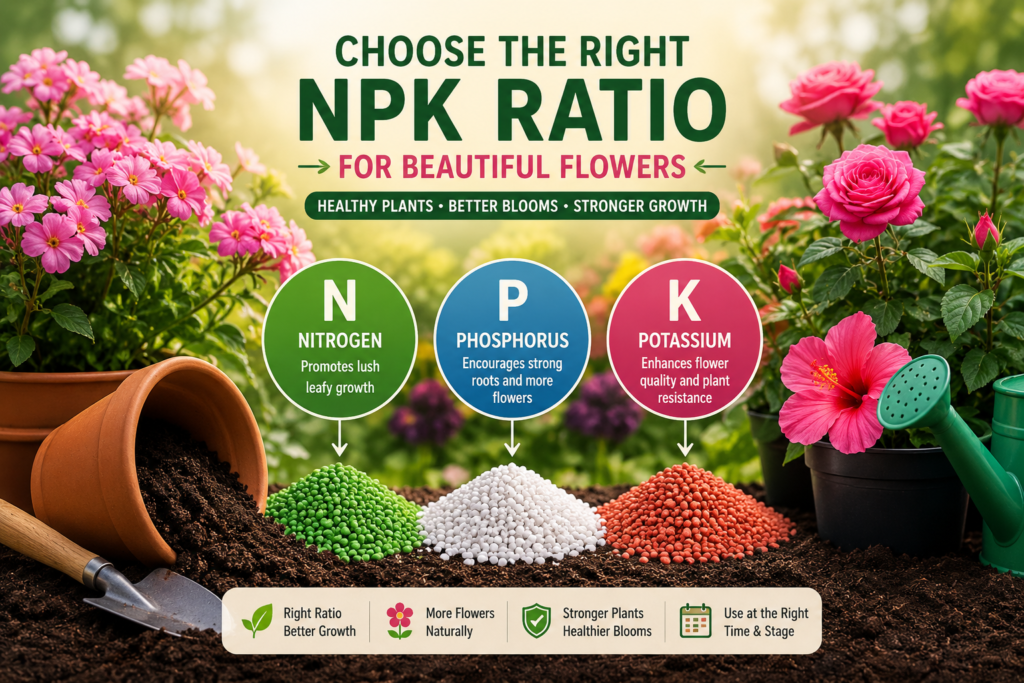
- Nitrogen (N) promotes leafy growth.
- Phosphorus (P) supports root development and flower initiation.
- Potassium (K) improves flowering, bloom quality, and plant resilience.
- Young plants generally require balanced nutrition.
- Flowering plants often benefit from increased phosphorus and potassium during blooming.
- More phosphorus does not always produce more flowers.
- Healthy soil and proper watering are just as important as fertilizer selection.
- Always follow the fertilizer label and avoid overfeeding.
What Is NPK?
Short answer: NPK refers to the three primary plant nutrients—Nitrogen (N), Phosphorus (P), and Potassium (K)—listed on every fertilizer label.
Every flowering plant needs these three macronutrients, but not always in the same proportion. The numbers printed on a fertilizer package, such as 19-19-19 or 10-26-26, indicate the percentage of nitrogen, phosphorus, and potassium available in that fertilizer.
Understanding NPK ratios also makes it easier to choose the best fertilizers for flowering plants, whether you prefer organic fertilizers, water-soluble fertilizers, or balanced NPK formulations.
| Nutrient | Main Role | Deficiency Symptoms |
|---|---|---|
| Nitrogen (N) | Leaf and stem growth | Pale leaves, slow growth |
| Phosphorus (P) | Roots, flower buds, energy transfer | Poor flowering and weak roots |
| Potassium (K) | Bloom quality, disease resistance, stress tolerance | Weak stems, poor flowers, scorched leaf edges |
Plants require all three nutrients throughout their life cycle, but the ideal ratio changes depending on whether the plant is producing leaves, roots, flower buds, or blooms.
Why Choosing the Right NPK Ratio Matters
Short answer: Using the correct NPK ratio helps plants produce healthier roots, stronger stems, abundant flowers, and longer-lasting blooms while avoiding unnecessary nutrient imbalances.
Many flowering problems are not caused by a lack of fertilizer but by using the wrong fertilizer at the wrong stage of growth. For example, a fertilizer high in nitrogen can encourage lush green foliage but reduce flower production if used excessively during the blooming stage.
On the other hand, supplying sufficient phosphorus and potassium during bud formation supports flower initiation, stronger stems, improved color, and better overall plant performance.
Key Takeaway
Healthy flowering plants require balanced nutrition throughout their life cycle. Instead of choosing fertilizers based solely on high phosphorus numbers, match the NPK ratio to the plant’s current growth stage and growing conditions.
How to Read NPK Numbers on Fertilizer Labels
Short answer: The three numbers on a fertilizer label represent the percentage of nitrogen, phosphorus, and potassium by weight.
For example:
| Fertilizer | Meaning | Best Use |
|---|---|---|
| 19-19-19 | Balanced nutrients | General plant growth |
| 10-26-26 | Lower nitrogen, higher phosphorus & potassium | Flower initiation |
| 00-52-34 | Very high phosphorus & potassium | Specific deficiency correction (not routine use) |
| 13-00-45 | High potassium | Flower quality and stress management |
Although fertilizers with higher phosphorus are commonly marketed for flowering plants, continuously using them without understanding your soil or plant requirements may lead to nutrient imbalance. Choosing the correct fertilizer is about matching nutrition to the plant’s growth stage rather than selecting the highest NPK numbers.
Best NPK Ratio for Flowering Plants
Knowing how to choose the right NPK ratio for flowering plants helps you select the best fertilizer based on the plant’s growth stage rather than using the same fertilizer throughout the season.
Short answer: There is no single best NPK ratio for every flowering plant. Different growth stages require different nutrient balances.
If you’re also growing vegetables, read our guide on Best Fertilizers for Vegetable Gardens in India.
| NPK Ratio | Best Use | Suitable For |
|---|---|---|
| 19-19-19 | Balanced growth | General maintenance of most flowering plants |
| 20-20-20 | Overall plant development | Potted flowering plants and ornamentals |
| 10-26-26 | Bud formation | Plants preparing to flower |
| 13-00-45 | Flower quality and stress tolerance | Blooming plants |
| 00-52-34 | Correcting phosphorus deficiency | Only when required |
Gardener’s Tip
Most flowering plants perform better with a balanced fertilizer during vegetative growth followed by fertilizers containing relatively more phosphorus and potassium during flowering rather than feeding high-phosphorus fertilizers throughout the season.
How to Choose the Right NPK Ratio for Flowering Plants Based on Growth Stage
Short answer: Healthy flowering depends on supplying the right nutrients at the right time.
| Growth Stage | Recommended Nutrition | Purpose |
|---|---|---|
| Seedling | Balanced nutrition | Healthy root and leaf development |
| Vegetative Growth | Balanced NPK | Strong stems and foliage |
| Bud Formation | Higher phosphorus | Supports flower bud initiation |
| Flowering | Higher potassium with balanced nutrition | Improves flower size, colour and longevity |
| Post Flowering | Light balanced feeding | Plant recovery and future growth |
Changing fertilizer according to plant development is generally more effective than applying the same fertilizer throughout the growing season.
Best NPK Ratio for Different Flowering Plants
Short answer: Different flowering plants respond differently to fertilizer depending on their growth habit and flowering pattern.
| Flowering Plant | Recommended Feeding Strategy | Focus |
|---|---|---|
| Rose | Balanced fertilizer followed by higher potassium during flowering | Large blooms and repeat flowering |
| Hibiscus | Balanced nutrition with additional potassium | Continuous flowering |
| Jasmine | Moderate nitrogen with phosphorus and potassium | Fragrance and flower production |
| Bougainvillea | Lower nitrogen, higher potassium | Heavy blooming |
| Marigold | Balanced fertilizer during growth | Continuous flowers |
| Petunia | Regular balanced feeding | Long flowering period |
| Chrysanthemum | Higher phosphorus before blooming | Bud development |
Signs Your Flowering Plants Need More Nutrients
Short answer: Slow growth, reduced flowering, pale leaves and weak stems may indicate nutrient deficiencies, although watering problems, poor sunlight and pests can produce similar symptoms.
- Small flowers
- Few flower buds
- Yellow older leaves
- Weak stems
- Slow growth
- Poor root development
- Flower buds dropping before opening
Before applying additional fertilizer, confirm that the plant receives adequate sunlight, watering and drainage because nutrient deficiencies are not always the primary cause of poor flowering.
Organic vs Chemical Fertilizers for Flowering Plants
Short answer: Organic fertilizers improve soil health over time, while chemical fertilizers provide nutrients more quickly. Many gardeners successfully combine both approaches.
| Feature | Organic Fertilizers | Chemical Fertilizers |
|---|---|---|
| Nutrient release | Slow | Fast |
| Improves soil | Yes | No |
| Microbial activity | Excellent | Minimal |
| Risk of overfeeding | Lower | Higher |
| Long-term soil health | Excellent | Depends on management |
| Visible response | Gradual | Usually quicker |
Recommended Organic Fertilizers
- Bone Meal
- Seaweed Extract
- Potash Meal
- Compost
- Vermicompost
- Neem Cake
- Humic Acid
- Mycorrhiza
Best Fertilizers for Flowering Plants
Choosing the best fertilizers for flowering plants depends on the plant species, growth stage, and soil condition. While balanced NPK fertilizers provide essential nutrients, combining them with organic fertilizers such as compost, bone meal, seaweed extract, potash meal, and mycorrhiza can support healthier roots, better flowering, and long-term soil health.
Rather than relying on a single product, many experienced gardeners use a combination of organic soil conditioners and balanced fertilizers to encourage continuous blooming.
Common NPK Mistakes That Reduce Flowering
Short answer: Most flowering problems occur because gardeners apply too much nitrogen or fertilize without considering the plant’s growth stage.
- Using high nitrogen fertilizers throughout the season.
- Applying fertilizer to dry soil.
- Overfeeding container plants.
- Ignoring soil quality.
- Using high phosphorus fertilizers unnecessarily.
- Not watering after granular fertilizer application where recommended.
- Applying fertilizers during extreme afternoon heat.
- Increasing fertilizer dosage instead of identifying the real problem.
Avoid This Common Myth
More fertilizer does not automatically produce more flowers. Excess fertilizer often causes excessive leafy growth, salt accumulation and reduced flowering. Healthy blooms depend on balanced nutrition, proper watering, sufficient sunlight and healthy soil.
Recommended Fertilizers for Flowering Plants
Short answer: Different fertilizers support different aspects of flowering. The products below can help improve soil health, root growth, flowering, and overall plant performance when used according to label directions.
| GreenKheti Product | Best For | Use Stage | Main Benefit | Buy Now |
|---|---|---|---|---|
| Flower Booster | Flowering plants | Bud & Bloom Stage | Supports abundant flowering and healthy blooms |
Website Amazon |
| Seaweed Extract | Plant stress & flowering | Throughout Growth | Improves flowering, stress tolerance and nutrient uptake |
Website Amazon |
| Power Meal Bone Meal | Flower bud development | Before Flowering | Natural phosphorus source for healthy flowering |
Website Amazon |
| NutriK Potash Meal | Bloom quality | Flowering Stage | Provides organic potassium for bigger, healthier flowers |
Website Amazon |
| Humic Acid 98% | Weak plants | Vegetative Stage | Improves nutrient availability and stronger root growth |
Website Amazon |
| MycoMagic Mycorrhiza | Root development | Planting & Transplanting | Promotes healthier roots and efficient nutrient uptake |
Website Amazon |
Why We Recommend These Products
No single fertilizer can meet every flowering plant’s nutritional needs throughout its life cycle. Building healthy soil, encouraging strong roots, and providing balanced nutrition during bud formation and flowering generally results in healthier plants and longer-lasting blooms.
Best Practices for Using NPK Fertilizer on Flowering Plants
Short answer: Apply fertilizers consistently, avoid overfeeding, and match nutrition to the plant’s growth stage.
- Start with healthy, well-drained soil.
- Use compost or organic matter before planting.
- Apply balanced fertilizer during vegetative growth.
- Increase phosphorus and potassium only during flowering when appropriate.
- Water before applying concentrated fertilizers if required.
- Avoid fertilizing during extreme afternoon heat.
- Remove spent flowers regularly to encourage repeat blooming.
- Follow label directions carefully.
Frequently Asked Questions
What is the best NPK ratio for flowering plants?
Balanced fertilizers such as 19-19-19 are suitable for general growth, while fertilizers with relatively higher phosphorus and potassium are commonly used during bud formation and flowering.
Does higher phosphorus always produce more flowers?
No. Flowering depends on balanced nutrition, healthy roots, sunlight, watering, and proper plant care. Excess phosphorus does not necessarily increase flowering.
Can too much nitrogen reduce flowering?
Yes. Excess nitrogen often encourages leafy growth at the expense of flowers.
How often should flowering plants be fertilized?
The schedule depends on the plant species, fertilizer type, growing medium, and weather. Always follow the manufacturer’s instructions.
Which fertilizer is best for roses?
Roses generally benefit from balanced feeding during growth and fertilizers with additional potassium during flowering.
Can I use organic fertilizers only?
Yes. Compost, bone meal, seaweed extract, potash meal, vermicompost, and neem cake can successfully support many flowering plants when used properly.
Should I fertilize flowering plants in pots more often?
Yes. Container plants lose nutrients more quickly because of regular watering and limited growing media.
What is the difference between NPK 19-19-19 and 10-26-26?
19-19-19 provides balanced nutrition, while 10-26-26 contains relatively more phosphorus and is often used during bud formation.
Can fertilizers burn flowering plants?
Yes. Excess fertilizer or incorrect application may damage roots, cause leaf burn, and reduce flowering.
Should I water after applying fertilizer?
Granular fertilizers generally benefit from watering after application, while water-soluble fertilizers are mixed according to label directions.
Is soil testing necessary for flowering plants?
A soil test helps identify nutrient deficiencies and pH issues, allowing more accurate fertilizer selection.
Can seaweed extract replace NPK fertilizer?
No. Seaweed extract is a biostimulant that supports plant health but does not replace complete fertilizers supplying adequate nitrogen, phosphorus, and potassium.
Conclusion
Choosing the right NPK ratio for flowering plants is about supplying balanced nutrition at the appropriate growth stage rather than using the highest phosphorus fertilizer available. Healthy soil, proper watering, adequate sunlight, and consistent plant care work together with fertilizers to produce beautiful blooms.
Most gardeners achieve the best long-term results by building fertile soil with organic matter, supporting root development, and adjusting fertilizer according to the plant’s stage of growth instead of applying the same fertilizer throughout the season.
References
- Indian Council of Agricultural Research (ICAR) – Official resources on plant nutrition, soil fertility, and fertilizer recommendations.
- Indian Institute of Horticultural Research (IIHR) – Research and publications on horticulture, flowering plants, and nutrient management.
- Food and Agriculture Organization (FAO) – International guidance on sustainable soil management and plant nutrition.
