

Comparisons
Humic Acid vs Seaweed Extract: Which Is Better for Your Plants?
Jul
Compare humic acid and seaweed extract to understand their benefits, differences, plant uses, nutrient uptake, soil health, and discover when to use each for the best gardening results.
Quick Answer: Humic Acid vs Seaweed Extract
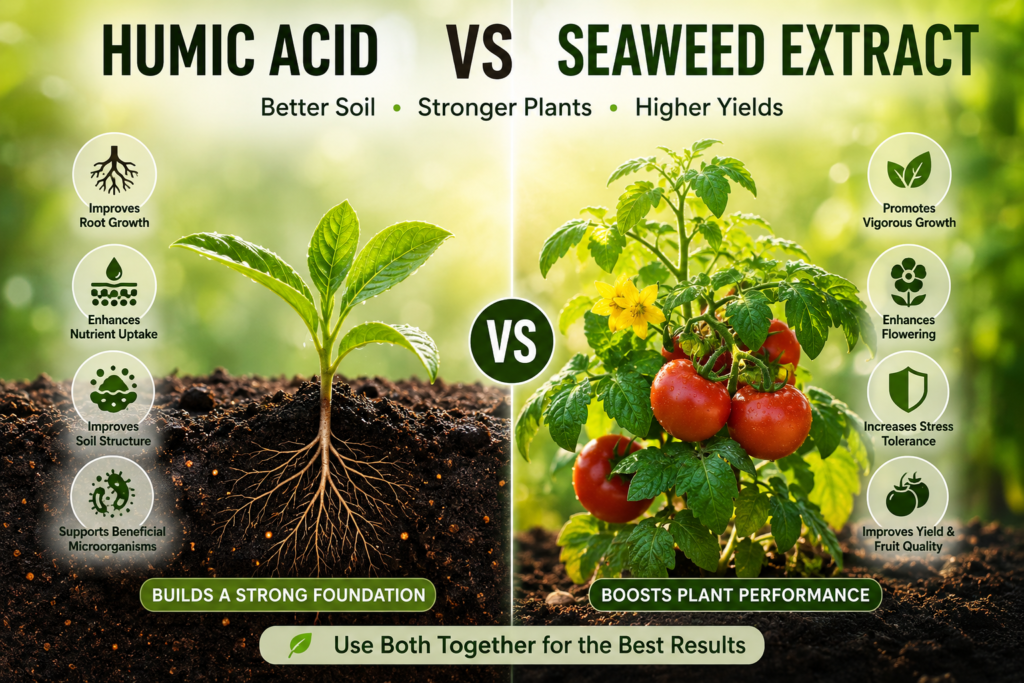
Humic acid and seaweed extract are both organic plant biostimulants, but they serve different purposes. Humic acid primarily improves soil fertility, root development, and nutrient uptake, making it ideal for weak soil and stronger root systems. Seaweed extract works directly on plant growth by supplying natural growth compounds, improving stress tolerance, encouraging flowering, and enhancing overall plant vigor. Rather than choosing one over the other, many gardeners achieve the best results by using both together because they complement each other.
Key Takeaways
- Humic acid mainly improves the soil and root zone.
- Seaweed extract mainly stimulates plant growth.
- Humic acid increases nutrient availability.
- Seaweed extract improves flowering and stress tolerance.
- Both products are suitable for organic gardening.
- Both can be applied together for better overall results.
- Neither product completely replaces balanced fertilizers.
- The best choice depends on your plant's current needs.
Table of Contents
Humic Acid vs Seaweed Extract
Humic acid and seaweed extract are among the most popular organic plant supplements used by gardeners, farmers, and horticulturists worldwide. Although they are often recommended together, they are frequently misunderstood because they work in completely different ways. Many gardeners ask which product is better, whether they should choose one over the other, or if both can be used together.
The answer depends on what your plants actually need. If your soil has poor nutrient availability, weak root development, or low organic matter, humic acid is usually the better choice because it improves the soil environment and helps roots absorb nutrients more efficiently. On the other hand, if plants are experiencing transplant shock, heat stress, slow flowering, or reduced growth, seaweed extract provides natural plant stimulants that help plants recover and grow more vigorously.
Unlike traditional fertilizers that mainly supply nutrients such as nitrogen, phosphorus, and potassium (NPK), both humic acid and seaweed extract belong to a group of products known as plant biostimulants. These products help plants use nutrients more efficiently, improve growth, strengthen roots, and increase resilience against environmental stress without acting as primary nutrient sources.
Understanding these differences can save money, improve plant health, and help you select the right product for vegetables, flowering plants, fruit trees, indoor plants, lawns, herbs, and container gardens.
In this comprehensive comparison, you'll learn how humic acid and seaweed extract work, their advantages and disadvantages, when to use each product, whether they can be mixed together, and which one is best for different gardening situations.
What Is Humic Acid?
Humic acid is a naturally occurring organic substance formed through the decomposition of plants, leaves, and other organic materials over thousands of years. It is commonly extracted from leonardite, peat, lignite, or naturally decomposed organic matter and is widely used as a soil conditioner.
Instead of directly feeding plants, humic acid improves the soil itself. It increases nutrient retention, stimulates beneficial microorganisms, improves soil structure, enhances water-holding capacity, and helps roots absorb nutrients more efficiently.
Main Benefits of Humic Acid
- Improves nutrient uptake.
- Encourages stronger root development.
- Improves soil structure.
- Supports beneficial soil microbes.
- Increases water retention.
- Reduces nutrient leaching.
- Improves fertilizer efficiency.
- Supports long-term soil fertility.
Because of these benefits, humic acid is commonly used in vegetable gardens, fruit orchards, flower beds, lawns, and commercial agriculture where soil quality needs long-term improvement.
What Is Seaweed Extract?
Seaweed extract is a natural plant biostimulant produced from marine algae, especially brown seaweeds such as Ascophyllum nodosum, Ecklonia maxima, and other nutrient-rich species. It contains natural plant growth compounds, amino acids, vitamins, carbohydrates, trace minerals, and antioxidants that stimulate healthy plant growth.
Unlike humic acid, seaweed extract acts mainly on the plant rather than the soil. It improves photosynthesis, increases chlorophyll production, stimulates flowering, supports fruit development, and helps plants tolerate drought, heat, frost, and transplant shock.
Main Benefits of Seaweed Extract
- Stimulates plant growth naturally.
- Improves flowering and fruiting.
- Enhances stress tolerance.
- Supports healthy leaf development.
- Encourages stronger root growth.
- Improves crop quality.
- Promotes faster recovery after transplanting.
- Works well as a foliar spray or soil drench.
Because seaweed extract contains naturally occurring plant hormones such as auxins, cytokinins, and betaines, it is especially useful during periods of rapid growth, flowering, fruiting, or environmental stress.
Humic Acid vs Seaweed Extract: The Biggest Difference
The simplest way to understand these two products is to remember that humic acid primarily improves the soil, while seaweed extract primarily improves the plant. One enhances the environment in which roots grow, while the other stimulates plant growth processes directly.
Humic Acid → Better Soil → Better Roots → Better Nutrient Uptake
Seaweed Extract → Better Plant Growth → Better Flowers → Better Fruits → Better Stress Tolerance
Because they perform different roles, many experienced gardeners and commercial growers use both products together rather than treating them as competing alternatives.
Humic Acid vs Seaweed Extract: Complete Comparison
Although both products are classified as organic biostimulants, they serve different purposes. The table below compares their features to help you decide which one best suits your gardening goals.
| Feature | Humic Acid | Seaweed Extract |
|---|---|---|
| Main Purpose | Improve soil health | Stimulate plant growth |
| Works Mainly On | Soil | Plant |
| Improves Root Growth | ★★★★★ | ★★★★☆ |
| Improves Flowering | ★★★☆☆ | ★★★★★ |
| Improves Fruiting | ★★★☆☆ | ★★★★★ |
| Improves Soil Structure | ★★★★★ | ★☆☆☆☆ |
| Improves Nutrient Uptake | ★★★★★ | ★★★★☆ |
| Supports Soil Microbes | ★★★★★ | ★★★☆☆ |
| Stress Tolerance | ★★★☆☆ | ★★★★★ |
| Drought Resistance | ★★★★☆ | ★★★★★ |
| Heat Stress Recovery | ★★★☆☆ | ★★★★★ |
| Best Application | Soil Drench | Foliar Spray & Soil Drench |
| Works Immediately | No | Yes |
| Long-Term Benefits | Excellent | Good |
| Organic Gardening | Yes | Yes |
How Humic Acid Works
Humic acid acts primarily as a soil conditioner. Instead of directly supplying nutrients like nitrogen or phosphorus, it improves the soil's ability to retain and exchange nutrients around plant roots.
When humic acid is added to the soil, it binds nutrients and water, reducing nutrient leaching while making minerals easier for plant roots to absorb. It also stimulates beneficial microorganisms that naturally recycle nutrients and improve soil structure.
Humic Acid Improves
- Root development
- Soil aeration
- Nutrient retention
- Water-holding capacity
- Beneficial microbial activity
- Overall soil fertility
Gardeners often notice healthier root systems, stronger stems, greener foliage, and improved fertilizer efficiency after regular humic acid applications.
How Seaweed Extract Works
Seaweed extract functions differently from humic acid because it works directly on plant metabolism. It contains naturally occurring biostimulants that encourage vigorous growth without replacing fertilizers.
Seaweed is naturally rich in compounds such as cytokinins, auxins, betaines, amino acids, carbohydrates, vitamins, and trace minerals. These substances stimulate cell division, improve chlorophyll production, increase stress resistance, and encourage flowering and fruit development.
| Natural Compound | Benefit |
|---|---|
| Auxins | Stimulate root development. |
| Cytokinins | Promote cell division and branching. |
| Betaines | Increase drought and heat tolerance. |
| Amino Acids | Support plant metabolism. |
| Trace Minerals | Improve overall plant health. |
Which Product Works Faster?
Seaweed extract usually produces visible results more quickly because it acts directly on the plant. Gardeners often notice greener leaves, improved vigor, and faster recovery within days after application.
Humic acid generally works more slowly because it improves soil conditions first. As soil biology and nutrient availability improve, plants gradually develop stronger roots and healthier long-term growth.
Need quick plant recovery? Choose Seaweed Extract.
Need long-term soil improvement? Choose Humic Acid.
Humic Acid vs Seaweed Extract: Which Provides Longer-Lasting Benefits?
Humic acid generally provides longer-lasting improvements because it enhances soil quality over time. Healthier soil continues supporting plant growth long after application.
Seaweed extract provides faster but shorter-term stimulation. Regular applications during the growing season help maintain vigorous growth, flowering, and stress resistance.
Soil Improvement vs Plant Growth
| Goal | Best Choice |
|---|---|
| Improve Soil Fertility | Humic Acid |
| Increase Root Growth | Humic Acid |
| Improve Nutrient Uptake | Humic Acid |
| Reduce Transplant Shock | Seaweed Extract |
| Increase Flowering | Seaweed Extract |
| Increase Fruit Quality | Seaweed Extract |
| Improve Stress Tolerance | Seaweed Extract |
| Maximum Overall Performance | Use Both Together |
Humic Acid vs Seaweed Extract: Which One Should You Choose?
The best choice depends entirely on your gardening goal. Since humic acid and seaweed extract perform different functions, choosing the right product becomes much easier when you first identify the problem your plants are facing.
| If You Want To... | Recommended Product |
|---|---|
| Improve poor soil | Humic Acid |
| Increase nutrient uptake | Humic Acid |
| Develop stronger roots | Humic Acid |
| Reduce transplant shock | Seaweed Extract |
| Improve flowering | Seaweed Extract |
| Increase fruit quality | Seaweed Extract |
| Help plants recover from stress | Seaweed Extract |
| Achieve maximum plant performance | Humic Acid + Seaweed Extract |
Can You Use Humic Acid and Seaweed Extract Together?
Yes. In fact, many professional growers and experienced gardeners apply both products together because they complement each other rather than compete. Humic acid improves the soil and nutrient availability, while seaweed extract stimulates plant growth and improves stress tolerance.
Using both products can provide healthier roots, better nutrient absorption, stronger vegetative growth, improved flowering, and greater resilience during environmental stress.
Why They Work Well Together
- Humic acid improves nutrient availability.
- Seaweed extract helps plants use those nutrients efficiently.
- Roots become stronger.
- Plants tolerate heat and drought better.
- Flowering and fruiting improve.
- Overall plant vigor increases.
Recommended Application Schedule
Application frequency depends on plant type, growing season, and product concentration. Always follow the product label instructions.
| Growth Stage | Humic Acid | Seaweed Extract |
|---|---|---|
| Seedlings | Light soil drench | Light foliar spray |
| Vegetative Growth | Every 2–4 weeks | Every 10–15 days |
| Flowering | Monthly | Every 10–14 days |
| Fruiting | Monthly | Every 10–14 days |
| Heat or Drought Stress | As required | Immediately after stress |
Best Plants for Humic Acid and Seaweed Extract
| Plant Type | Best Choice | Reason |
|---|---|---|
| Vegetables | Both | Healthy roots and higher yields. |
| Flowering Plants | Seaweed Extract | Improves blooming. |
| Fruit Trees | Both | Better nutrient uptake and fruit quality. |
| Indoor Plants | Humic Acid | Improves potting soil health. |
| Succulents | Seaweed Extract | Light growth stimulation. |
| Lawns | Humic Acid | Improves soil structure. |
| Herbs | Both | Healthy foliage and roots. |
| Container Gardens | Both | Supports long-term growth. |
Real Gardening Scenarios: Which Product Should You Use?
| Situation | Best Choice |
|---|---|
| Newly transplanted seedlings | Seaweed Extract |
| Hard, compact soil | Humic Acid |
| Yellow leaves due to poor nutrient uptake | Humic Acid |
| Plants damaged by heat | Seaweed Extract |
| Weak flowering hibiscus | Seaweed Extract |
| Poor root growth | Humic Acid |
| Preparing vegetable beds | Humic Acid |
| Maximum growth throughout the season | Use Both Together |
Humic Acid vs Seaweed Extract: Myths vs Facts
| Myth | Fact |
|---|---|
| They are the same product. | They have completely different functions. |
| Humic acid is a fertilizer. | It is primarily a soil conditioner. |
| Seaweed extract replaces NPK fertilizers. | It is a plant biostimulant, not a complete fertilizer. |
| You must choose only one. | Many gardeners use both together successfully. |
| More product gives better results. | Always follow the recommended dosage. |
GreenKheti Expert Tips
- Use humic acid when improving poor or compacted soil.
- Apply seaweed extract before flowering and during plant stress.
- Use both products together for vegetables and fruiting crops.
- Apply during the cooler hours of the day for best results.
- Avoid exceeding the recommended dosage.
- Combine these biostimulants with balanced fertilizers rather than replacing essential nutrients.
- Healthy soil and healthy plants work together—focus on improving both.
Recommended GreenKheti Products
Humic acid and seaweed extract work best when used as part of a complete plant nutrition program. Depending on your gardening goals, the following GreenKheti products can help improve soil health, nutrient uptake, root development, flowering, fruiting, and overall plant growth.
| Product | Best For | Learn More |
|---|---|---|
| Humic Acid | Soil health, nutrient uptake, stronger roots | Website | Amazon |
| Seaweed Extract | Growth, flowering, stress recovery | Website | Amazon |
| Neem Cake Powder | Healthy soil and beneficial microbes | Website | Amazon |
| Power Meal Bone Meal | Root development and flowering | Website | Amazon |
| MycoMagic Mycorrhiza | Root establishment and nutrient absorption | Website | Amazon |
| Epsom Salt | Magnesium deficiency correction | Website | Amazon |
Not Sure Which Product Your Plant Needs?
Every plant has different requirements depending on its growth stage, soil condition, and environmental stress. Instead of guessing, get personalized recommendations from the GreenKheti AI Plant Care WhatsApp Bot.
Frequently Asked Questions
Which is better, humic acid or seaweed extract?
Neither is universally better. Humic acid improves soil health and nutrient uptake, while seaweed extract stimulates plant growth, flowering, and stress tolerance.
Can humic acid and seaweed extract be used together?
Yes. They complement each other and are commonly used together to improve both soil quality and plant performance.
Is humic acid a fertilizer?
No. Humic acid is a soil conditioner that improves nutrient availability and root development but does not replace balanced fertilizers.
Is seaweed extract a complete fertilizer?
No. Seaweed extract is a plant biostimulant containing natural growth compounds and trace minerals. It should be used alongside a balanced nutrition program.
Which product improves flowering?
Seaweed extract is generally more effective for promoting flowering and fruit development because of its natural plant growth compounds.
Which product improves soil health?
Humic acid is specifically designed to improve soil structure, microbial activity, water retention, and nutrient availability.
Can I use humic acid for indoor plants?
Yes. Humic acid helps improve potting soil quality and nutrient uptake for indoor plants.
Can seaweed extract reduce transplant shock?
Yes. Seaweed extract is widely used to help plants recover from transplant stress and environmental changes.
How often should humic acid be applied?
Most products are applied every 2–4 weeks during active growth, but always follow the label directions.
How often should seaweed extract be applied?
Seaweed extract is commonly applied every 10–15 days during the growing season or during periods of plant stress.
Can these products replace NPK fertilizers?
No. They improve nutrient efficiency but should be used together with an appropriate fertilization program.
Which product is better for vegetables?
Using both products together often provides the best results because vegetables benefit from healthy soil and vigorous plant growth.
Are both products suitable for organic gardening?
Yes. High-quality humic acid and seaweed extract products are commonly used in organic and sustainable gardening systems.
Can I spray seaweed extract on leaves?
Yes. Seaweed extract is commonly used as a foliar spray as well as a soil drench, depending on the product instructions.
What gives the best overall results?
For most gardens, combining humic acid, seaweed extract, and a balanced fertilizer program provides healthier soil, stronger roots, improved flowering, and better yields.
Conclusion
Humic acid and seaweed extract are not competing products—they solve different problems. Humic acid strengthens the soil by improving nutrient availability, microbial activity, and root development, while seaweed extract strengthens the plant by promoting vigorous growth, flowering, fruiting, and resilience against environmental stress.
If your goal is healthier soil, choose humic acid. If you want stronger plant growth and better flowering, choose seaweed extract. For gardeners seeking the best overall performance, using both products together as part of a balanced nutrition program is often the most effective approach.
Continue Reading
References
- Food and Agriculture Organization (FAO) – Plant Production and Protection
- ICAR – Indian Institute of Horticultural Research (IIHR)
- Ministry of Agriculture & Farmers Welfare, Government of India
- Royal Horticultural Society (RHS)
- University of Minnesota Extension – Gardening Resources
- Michigan State University Extension – Plant & Soil Science
- University of Wisconsin–Madison Extension Horticulture
