
Plant Nutrition & Fertilizers
Liquid vs Granular Fertilizers: Which Is Better for Your Plants?
Jul
Compare liquid and granular fertilizers, understand their advantages, disadvantages, nutrient absorption, application methods, and discover which fertilizer is best for vegetables, flowers, indoor plants, fruit trees, and lawns.
AI Quick Answer
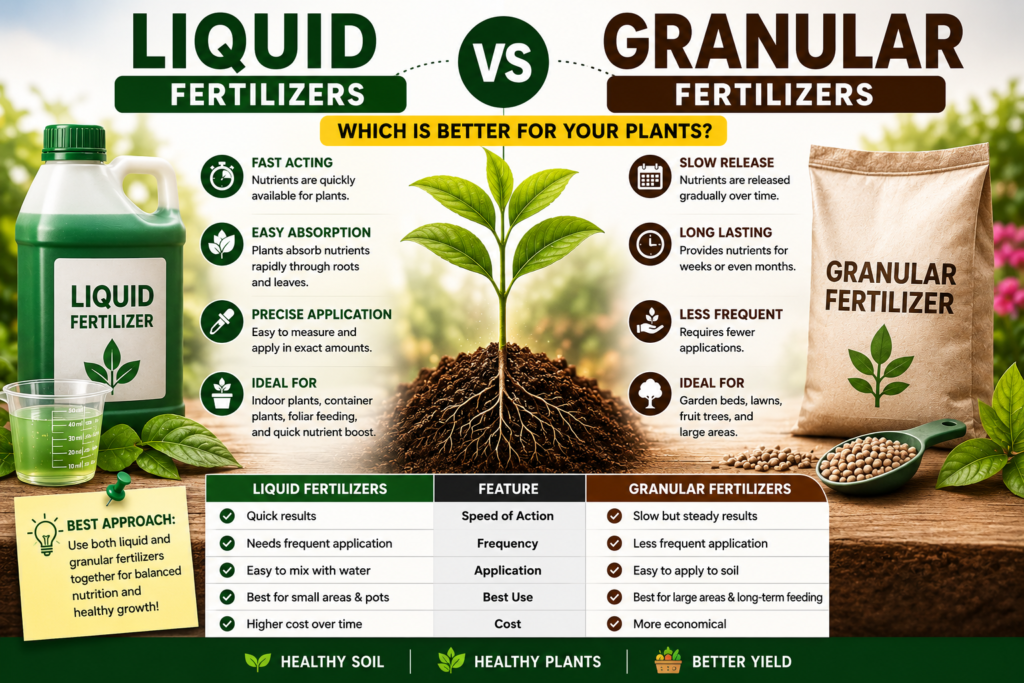
Liquid vs granular fertilizers is a common comparison for gardeners choosing the best way to feed their plants. Liquid fertilizers provide nutrients quickly because they are already dissolved in water, making them ideal for correcting deficiencies and supporting rapid growth. Granular fertilizers release nutrients more slowly, offering long-lasting nutrition with fewer applications. The best choice depends on your plant type, growth stage, soil condition, and whether you need immediate or sustained nutrient availability.
Key Takeaways
- Liquid fertilizers provide faster nutrient availability than granular fertilizers.
- Granular fertilizers usually last longer and require fewer applications.
- Liquid fertilizers are excellent for correcting nutrient deficiencies quickly.
- Granular fertilizers are suitable for long-term feeding and soil application.
- Both fertilizer types can be effective when applied according to label directions.
- The right fertilizer depends on plant type, growth stage, and gardening goals.
- Proper dosage and application timing improve fertilizer efficiency.
Table of Contents
Liquid vs Granular Fertilizers: Understanding the Difference
Choosing between liquid and granular fertilizers is an important decision for gardeners who want healthier plants, better flowering, higher yields, and efficient nutrient management. Both fertilizer types supply essential nutrients, but they differ in how nutrients are delivered, how quickly plants absorb them, how long they remain available, and how they are applied.
Liquid fertilizers are mixed with water and applied directly to the soil or foliage. Since nutrients are already dissolved, plants can absorb them quickly, making liquid fertilizers ideal for rapid growth and correcting nutrient deficiencies.
Granular fertilizers are dry products applied around plants or mixed into the soil. They gradually dissolve with watering or rainfall, releasing nutrients over time. This slow-release nature provides consistent nutrition and often requires fewer applications than liquid fertilizers.
Understanding these differences helps you choose the right fertilizer for vegetables, flowering plants, indoor plants, fruit trees, lawns, and container gardens. This guide compares both fertilizer types to help you make an informed decision.
What Are Liquid Fertilizers?
Liquid fertilizers are plant nutrients dissolved or suspended in water. They are commonly applied using watering cans, sprayers, drip irrigation systems, or fertigation equipment. Because nutrients are already available in solution, plants can absorb them quickly through their roots and, in some cases, through their leaves during foliar application.
Liquid fertilizers are widely used when plants need rapid nutrient availability, especially during active growth, flowering, fruit development, or when correcting nutrient deficiencies.
Common Examples of Liquid Fertilizers
- Liquid Seaweed Extract
- Liquid Humic Acid
- Liquid NPK Fertilizers
- Fish Emulsion
- Liquid Compost Tea
- Calcium Nitrate Solution
- Water-Soluble Fertilizers
- Micronutrient Liquid Fertilizers
What Are Granular Fertilizers?
Granular fertilizers are dry fertilizer products available as granules, pellets, or powders that are applied directly to the soil. After watering or rainfall, the granules gradually dissolve and release nutrients for plant uptake.
Granular fertilizers are popular because they are easy to store, simple to apply, and often provide nutrients over a longer period than liquid fertilizers. They are commonly used for vegetables, flowering plants, fruit trees, lawns, and landscape plants.
Common Examples of Granular Fertilizers
- Neem Cake Powder
- Bone Meal
- NPK Granules
- DAP (Diammonium Phosphate)
- Urea Granules
- MOP (Muriate of Potash)
- Mycorrhiza Biofertilizer
- Organic Potash Meal
- Gypsum
Liquid vs Granular Fertilizers at a Glance
| Feature | Liquid Fertilizers | Granular Fertilizers |
|---|---|---|
| Application Method | Mixed with water and applied by watering or spraying | Applied directly to soil |
| Nutrient Availability | Very Fast | Gradual |
| Duration | Short-term | Long-lasting |
| Best For | Quick nutrient correction | Long-term feeding |
| Frequency | More frequent applications | Less frequent applications |
| Foliar Application | Possible | Not applicable |
| Ease of Storage | Moderate | Easy |
| Suitable For | Rapid plant response | Steady plant growth |
How Liquid Fertilizers Work
Liquid fertilizers contain nutrients that are already dissolved or suspended in water. When applied to the soil, plant roots can absorb these nutrients almost immediately. Some liquid fertilizers can also be sprayed directly onto leaves (foliar feeding), allowing plants to absorb certain nutrients through leaf surfaces.
Because nutrients become available quickly, liquid fertilizers are often used to correct nutrient deficiencies, support rapid vegetative growth, encourage flowering, or boost fruit development during critical growth stages.
How Nutrients Reach the Plant
- Liquid fertilizer is diluted according to label instructions.
- The solution is applied to the soil or leaves.
- Nutrients dissolve completely in soil moisture.
- Roots or leaves absorb available nutrients quickly.
- Plants respond with faster visible growth.
How Granular Fertilizers Work
Granular fertilizers are spread around plants or incorporated into the soil. After watering or rainfall, the granules gradually dissolve and release nutrients over time. This slow-release process provides plants with a steady supply of nutrients and reduces the need for frequent applications.
Some granular fertilizers release nutrients over several weeks, while controlled-release formulations may continue feeding plants for months depending on the product and environmental conditions.
How Granular Fertilizers Feed Plants
- Granules are applied around the root zone.
- Water dissolves the fertilizer.
- Nutrients move into the soil solution.
- Roots gradually absorb available nutrients.
- Plants receive long-lasting nutrition.
Advantages of Liquid Fertilizers
- Provide nutrients quickly.
- Correct nutrient deficiencies faster.
- Ideal for foliar feeding.
- Easy to adjust fertilizer concentration.
- Suitable for drip irrigation and fertigation systems.
- Excellent during flowering and fruiting stages.
- Even nutrient distribution when applied correctly.
- Useful for container and indoor plants.
Limitations of Liquid Fertilizers
- Require more frequent applications.
- Nutrients may leach more quickly after heavy watering.
- Usually have a shorter feeding duration.
- Over-application may cause fertilizer burn.
- Preparation requires accurate dilution.
Advantages of Granular Fertilizers
- Provide long-lasting nutrition.
- Require fewer applications.
- Easy to store and transport.
- Suitable for large gardens and landscapes.
- Less preparation before application.
- Available in organic and synthetic formulations.
- Can improve soil fertility when organic products are used.
- Often more economical for larger areas.
Limitations of Granular Fertilizers
- Nutrients become available more slowly.
- Require watering after application.
- Uneven spreading may cause inconsistent growth.
- Not suitable for foliar feeding.
- Slower response when correcting nutrient deficiencies.
Scientific Explanation: Why Liquid Fertilizers Work Faster
Plants absorb nutrients as dissolved ions through their roots. Liquid fertilizers already contain nutrients in a dissolved form, allowing immediate absorption after application. Granular fertilizers must first dissolve in soil moisture before nutrients become available for uptake.
This difference in nutrient availability explains why liquid fertilizers produce faster visible results, while granular fertilizers provide a more gradual and sustained nutrient supply.
Regardless of fertilizer type, plant growth also depends on healthy soil, proper watering, sunlight, temperature, and balanced nutrient management.
Liquid vs Granular Fertilizers: Detailed Comparison
| Parameter | Liquid Fertilizers | Granular Fertilizers |
|---|---|---|
| Absorption Speed | Very Fast | Gradual |
| Nutrient Release | Immediate | Slow Release |
| Application Frequency | Higher | Lower |
| Ease of Application | Requires Mixing | Simple Broadcasting |
| Foliar Feeding | Yes | No |
| Suitable for Large Areas | Moderate | Excellent |
| Storage | Moderate | Easy |
| Long-Term Feeding | No | Yes |
| Quick Deficiency Correction | Excellent | Moderate |
| Best Use | Rapid Growth & Nutrient Correction | Routine Long-Term Nutrition |
Liquid vs Granular Fertilizers for Vegetable Gardens
Vegetable plants need balanced nutrition throughout their growing season. Liquid fertilizers provide rapid nutrient availability during active growth, flowering, and fruit development, while granular fertilizers offer a steady nutrient supply that supports long-term plant health.
Many gardeners achieve the best results by improving soil with granular fertilizers before planting and using liquid fertilizers during periods of rapid growth or when nutrient deficiencies appear.
| Growth Stage | Recommended Fertilizer | Reason |
|---|---|---|
| Soil Preparation | Granular | Provides long-lasting nutrition. |
| Seedling Stage | Liquid | Quick nutrient uptake. |
| Vegetative Growth | Both | Balanced nutrition. |
| Flowering | Liquid | Rapid nutrient support. |
| Fruiting | Liquid + Granular | Immediate and sustained nutrition. |
Liquid vs Granular Fertilizers for Flowering Plants
Flowering plants require phosphorus and potassium during bud formation and blooming. Liquid fertilizers can quickly support flowering, while granular fertilizers maintain continuous nutrient availability for healthy blooms throughout the season.
| Plant | Best Choice | Reason |
|---|---|---|
| Rose | Both | Continuous flowering. |
| Hibiscus | Liquid | Supports frequent blooming. |
| Marigold | Granular | Steady nutrient supply. |
| Bougainvillea | Granular + Liquid | Balanced flowering support. |
Liquid vs Granular Fertilizers for Indoor Plants
Indoor plants are commonly grown in containers with limited soil volume. Liquid fertilizers are popular because they provide controlled nutrition and are easy to apply in small amounts. Granular fertilizers can also be used but should be applied carefully to avoid excessive salt buildup in pots.
Recommendation:Liquid fertilizers are generally preferred for indoor plants because dosage can be adjusted easily according to plant size and growth stage.
Liquid vs Granular Fertilizers for Fruit Trees
Fruit trees benefit from long-term nutrient availability throughout the growing season. Granular fertilizers are commonly applied around the root zone, while liquid fertilizers can provide additional nutrition during flowering and fruit development.
- Granular fertilizers support long-term feeding.
- Liquid fertilizers encourage rapid nutrient uptake.
- Balanced fertilization improves fruit quality.
- Healthy roots absorb nutrients more efficiently.
Liquid vs Granular Fertilizers for Lawns
Granular fertilizers are widely used for lawns because they provide even coverage and long-lasting nutrition across large areas. Liquid fertilizers are useful when lawns require quick greening or rapid correction of nutrient deficiencies.
Liquid vs Granular Fertilizer Decision Guide
- Need fast results? → Choose Liquid Fertilizer.
- Want fewer applications? → Choose Granular Fertilizer.
- Growing indoor plants? → Liquid fertilizers are usually easier to manage.
- Maintaining lawns or fruit trees? → Granular fertilizers provide long-lasting nutrition.
- Need foliar feeding? → Use liquid fertilizers.
- Want both quick and long-term nutrition? → Combine liquid and granular fertilizers according to plant needs.
- Need personalized fertilizer advice? → Use the GreenKheti AI Plant Care WhatsApp Bot .
Common Mistakes When Using Liquid and Granular Fertilizers
- Applying more fertilizer than recommended.
- Using liquid fertilizers without proper dilution.
- Applying granular fertilizers without watering afterward.
- Fertilizing dry or heat-stressed plants.
- Ignoring fertilizer label instructions.
- Applying fertilizers at the wrong growth stage.
- Using one fertilizer for every plant type.
- Expecting instant results from slow-release fertilizers.
- Mixing incompatible fertilizers.
- Not monitoring plant response after application.
GreenKheti Expert Tips
- Use granular fertilizers during soil preparation for long-lasting nutrition.
- Apply liquid fertilizers during active growth, flowering, and fruiting.
- Always follow the manufacturer's recommended dosage.
- Water plants after applying granular fertilizers.
- Apply liquid fertilizers during the cooler parts of the day.
- Store fertilizers in a cool, dry place.
- Read fertilizer labels before every application.
- Observe plant growth regularly and adjust fertilization only when needed.
Recommended GreenKheti Products
Choosing between liquid and granular fertilizers depends on your plants' growth stage and nutritional requirements. Below are some GreenKheti products that can naturally support healthy plant growth and improve soil fertility.
| Product | Type | Best For | Learn More |
|---|---|---|---|
| Seaweed Extract | Liquid | Rapid growth, stress tolerance, foliar feeding | Website | Amazon |
| Humic Acid | Liquid | Root development and nutrient uptake | Website | Amazon |
| Neem Cake Powder | Granular | Long-term soil improvement | Website | Amazon |
| Power Meal Bone Meal | Granular | Root growth and flowering | Website | Amazon |
| MycoMagic Mycorrhiza | Granular | Root health and nutrient absorption | Website | Amazon |
| Epsom Salt | Water Soluble | Magnesium deficiency correction | Website | Amazon |
Need Help Choosing the Right Fertilizer?
Not sure whether your plants need a liquid fertilizer or a granular fertilizer? Chat with the GreenKheti AI Plant Care WhatsApp Bot for personalized fertilizer recommendations based on your plant type and growing conditions.
Frequently Asked Questions
Which is better, liquid or granular fertilizer?
Neither is universally better. Liquid fertilizers provide quick nutrient availability, while granular fertilizers offer long-lasting nutrition.
Can I use liquid and granular fertilizers together?
Yes. Many gardeners use granular fertilizers for routine feeding and supplement them with liquid fertilizers during rapid growth or nutrient deficiencies.
Which fertilizer works faster?
Liquid fertilizers work faster because nutrients are already dissolved and available for plant uptake.
Do granular fertilizers last longer?
Yes. Granular fertilizers generally release nutrients gradually, providing longer-lasting nutrition than most liquid fertilizers.
Which fertilizer is better for indoor plants?
Liquid fertilizers are usually preferred because they allow precise dosage and are easy to apply in containers.
Can liquid fertilizers be sprayed on leaves?
Many liquid fertilizers are suitable for foliar application when the product label specifically recommends it.
Do granular fertilizers require watering?
Yes. Watering helps dissolve the granules so nutrients become available for root absorption.
Which fertilizer is more economical?
Granular fertilizers are often more economical for larger gardens because they require fewer applications.
Can over-fertilizing damage plants?
Yes. Excess fertilizer can cause root damage, nutrient imbalance, and fertilizer burn regardless of the fertilizer type.
How do I choose the right fertilizer?
Choose fertilizers based on your plant species, growth stage, soil condition, and nutrient requirements while following label instructions.
Conclusion
Choosing between liquid and granular fertilizers depends on your gardening goals, plant type, and how quickly nutrients are needed. Liquid fertilizers provide rapid nutrient availability and are excellent for correcting deficiencies or supporting active growth. Granular fertilizers deliver long-lasting nutrition with fewer applications, making them ideal for routine feeding and larger gardens.
Many gardeners achieve the best results by combining both fertilizer types strategically—using granular fertilizers for steady nutrition and liquid fertilizers when plants require an immediate nutrient boost. Always read fertilizer labels carefully and follow the recommended application rates for healthy, productive plants.
Continue Reading
- Organic vs Chemical Fertilizers
- How to Read Fertilizer Labels
- Best Fertilizers for Vegetable Gardens
- How to Choose the Right NPK Ratio
- Best Fertilizers for Flowering Plants
- What Is NPK Fertilizer? A Complete Guide
- How to Use Neem Cake for Natural Pest Control
- Mycorrhiza Fertilizer: Uses, Benefits & Price in India
References
- Indian Council of Agricultural Research (ICAR)
- Indian Agricultural Research Institute (IARI)
- Tamil Nadu Agricultural University (TNAU) Agritech Portal
- ICAR – Indian Institute of Horticultural Research (IIHR)
- National Food Security Mission (NFSM)
- Soil Health Management – Government of India
- Soil Health Card Scheme
- Farmer Portal – Ministry of Agriculture & Farmers Welfare
- Food and Agriculture Organization (FAO)
