

Gardening Tips
What Is NPK Fertilizer? A Complete Guide
Jul
Learn what NPK fertilizer is, what the NPK numbers mean, why nitrogen, phosphorus and potassium are essential for plants, and how to choose the right NPK fertilizer for healthy growth.
Quick Answer
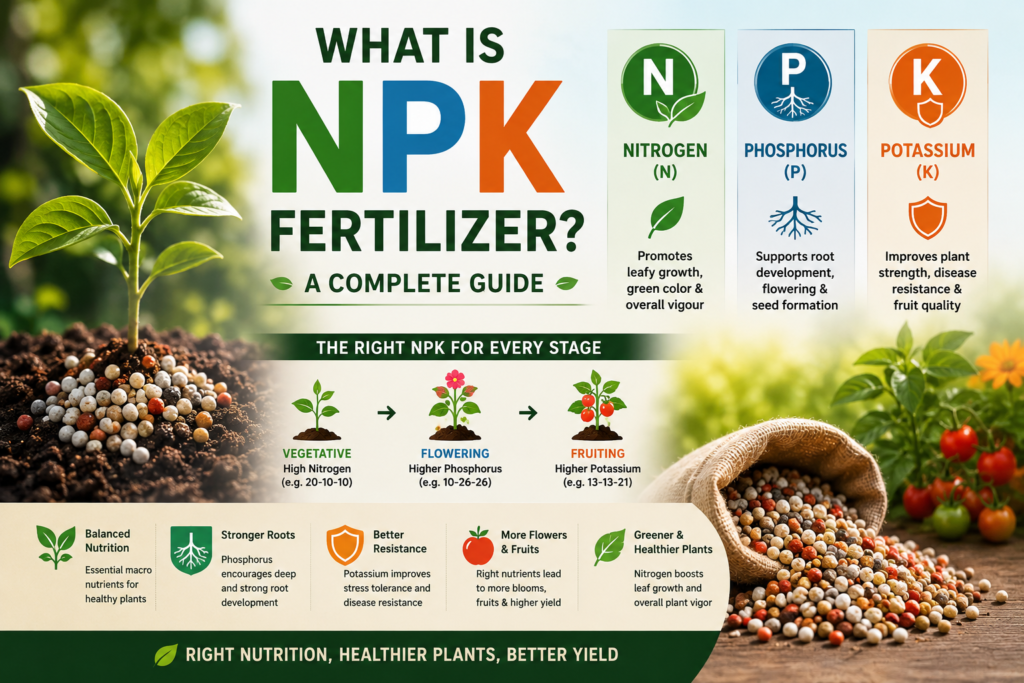
NPK fertilizer is a plant fertilizer containing three primary nutrients: Nitrogen (N), Phosphorus (P), and Potassium (K). These nutrients support leafy growth, root development, flowering, fruit production, and overall plant health. The numbers on an NPK fertilizer (such as 19-19-19 or 10-26-26) indicate the percentage of each nutrient in the product, helping gardeners choose the right fertilizer for different growth stages and plant types.
Key Takeaways
- NPK stands for Nitrogen, Phosphorus and Potassium.
- Each nutrient performs a different role in plant growth.
- NPK numbers represent the percentage of nutrients in a fertilizer.
- Different plants require different NPK ratios.
- Using the wrong fertilizer can reduce plant performance.
- Balanced nutrition is more important than applying excess fertilizer.
- Healthy soil improves fertilizer efficiency.
Introduction
Fertilizers play an important role in supplying plants with essential nutrients needed for healthy growth. Among all fertilizers, NPK fertilizer is one of the most commonly used because it provides the three primary nutrients that nearly every plant requires—nitrogen, phosphorus and potassium.
Whether you’re growing vegetables, flowering plants, fruit trees, herbs or indoor plants, understanding what NPK fertilizer is and how it works can help you choose the right product and avoid common fertilization mistakes.
In this guide, you’ll learn what NPK means, how the numbers on fertilizer labels work, the role of each nutrient, how to choose the right NPK ratio, and common mistakes to avoid.
Understanding NPK Fertilizer
NPK fertilizer is a plant fertilizer that supplies the three primary macronutrients essential for healthy growth: Nitrogen (N), Phosphorus (P), and Potassium (K). These nutrients support leaf development, root growth, flowering, fruit production, and overall plant health.
NPK fertilizers are available in various formulations, including granular, water-soluble, liquid, and slow-release products. The proportion of each nutrient is represented by three numbers on the fertilizer label, allowing gardeners to choose a formulation suited to different plants and growth stages.
What Does NPK Stand For?
The letters NPK represent the three primary nutrients required by plants:
| Nutrient | Symbol | Main Function |
|---|---|---|
| Nitrogen | N | Supports leafy growth and chlorophyll production. |
| Phosphorus | P | Promotes root development, flowering and seed formation. |
| Potassium | K | Improves plant strength, stress tolerance and fruit quality. |
Why Do Plants Need NPK Nutrients?
Plants require many nutrients to grow, but nitrogen, phosphorus and potassium are needed in the largest quantities. Together, these nutrients support nearly every stage of plant development—from seedling establishment and leaf production to flowering, fruiting and overall plant health.
- Encourages healthy vegetative growth.
- Supports stronger root systems.
- Promotes flowering and fruit production.
- Improves plant resistance to environmental stress.
- Enhances overall plant vigor and productivity.
Functions of Nitrogen, Phosphorus and Potassium
Nitrogen (N)
Nitrogen is responsible for producing green leaves and healthy stems. It is an important component of chlorophyll, which plants use to convert sunlight into energy through photosynthesis.
Phosphorus (P)
Phosphorus supports strong root development, energy transfer within the plant and plays an important role during flowering, fruiting and seed production.
Potassium (K)
Potassium helps regulate water movement, strengthens plant tissues, improves disease tolerance and contributes to better flower quality, fruit size and overall plant resilience.
Common NPK Fertilizer Ratios Explained
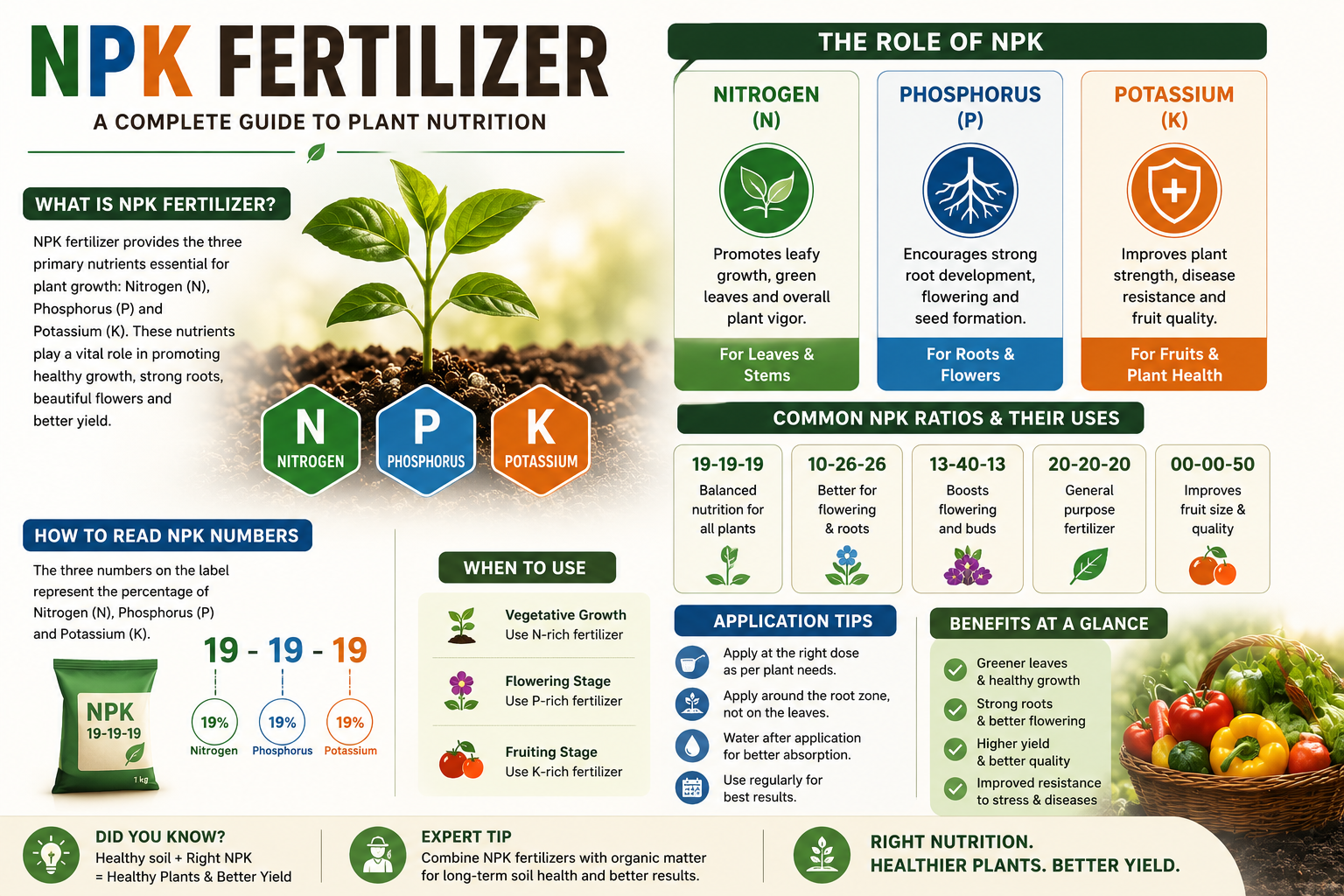
The three numbers printed on every NPK fertilizer package indicate the percentage of Nitrogen (N), Phosphorus (P), and Potassium (K) present in the fertilizer. Different ratios are designed for different plant growth stages and gardening needs.
| NPK Ratio | Best Used For | Typical Application |
|---|---|---|
| 19-19-19 | Balanced nutrition | General plant growth, vegetables, flowers and fruit plants |
| 10-26-26 | High phosphorus | Root development and flower bud initiation |
| 13-40-13 | Early flowering | Flowering plants and young fruit crops |
| 00-52-34 | Very high phosphorus | Root establishment and flowering support |
| 12-61-00 | Starter fertilizer | Seedlings and transplant establishment |
| 00-00-50 | High potassium | Fruit development and plant stress tolerance |
| 20-20-20 | Balanced feeding | General-purpose fertilizer for many crops |
How to Read NPK Fertilizer Numbers
Every NPK fertilizer label follows the same format. For example, a fertilizer labeled 19-19-19 contains 19% Nitrogen, 19% Phosphorus and 19% Potassium by weight. The remaining percentage consists of other ingredients that help deliver nutrients safely and effectively.
A 1 kg bag of 19-19-19 fertilizer contains approximately:
- 190 g Nitrogen
- 190 g Phosphorus
- 190 g Potassium
Which NPK Fertilizer Should You Choose?
The ideal NPK fertilizer depends on your plant’s growth stage rather than simply choosing the highest nutrient concentration.
| If Your Plant Needs… | Recommended NPK Type |
|---|---|
| Healthy leaves and stems | Balanced or Nitrogen-rich fertilizer |
| Strong root development | High phosphorus fertilizer |
| Better flowering | Higher phosphorus and potassium fertilizer |
| Fruit development | Higher potassium fertilizer |
| General garden maintenance | Balanced NPK fertilizer |
Organic vs Synthetic NPK Fertilizers
Both organic and synthetic fertilizers provide essential nutrients, but they differ in nutrient release, soil improvement and long-term effects.
| Organic Fertilizers | Synthetic NPK Fertilizers |
|---|---|
| Improve soil health | Supply nutrients quickly |
| Support beneficial microbes | Higher nutrient concentration |
| Slow nutrient release | Fast nutrient availability |
| Increase organic matter | Do not significantly improve soil structure |
Water-Soluble vs Granular NPK Fertilizers
| Water-Soluble | Granular |
|---|---|
| Acts quickly | Gradual nutrient release |
| Suitable for foliar spray and fertigation | Suitable for soil application |
| Requires more frequent application | Usually applied less frequently |
| Easy to adjust dosage | Convenient for large gardens |
Related Guides
How to Apply NPK Fertilizer Correctly
Applying NPK fertilizer correctly is just as important as choosing the right formulation. Over-fertilizing or applying fertilizer at the wrong growth stage can reduce plant performance and waste nutrients.
- Identify your plant’s current growth stage.
- Select an appropriate NPK ratio.
- Measure the fertilizer according to the label instructions.
- Apply evenly around the root zone.
- Avoid direct contact with stems and leaves unless using a foliar fertilizer.
- Water after applying granular fertilizers.
- Repeat applications only as recommended.
General NPK Fertilizer Application Guide
| Plant Type | Recommended NPK | Typical Growth Stage |
|---|---|---|
| Vegetables | Balanced NPK | Entire growing season |
| Flowering Plants | Higher phosphorus & potassium | Bud formation & flowering |
| Fruit Plants | Balanced → Higher potassium | Flowering & fruit development |
| Indoor Plants | Balanced NPK | Active growth |
| Lawns | Nitrogen-rich fertilizer | Growing season |
Common NPK Fertilizer Mistakes to Avoid
- Using the same NPK fertilizer for every plant.
- Applying fertilizer without checking plant growth stage.
- Over-fertilizing to speed up growth.
- Ignoring soil health and organic matter.
- Applying fertilizer to dry soil.
- Using high-phosphorus fertilizers unnecessarily.
- Ignoring soil testing.
- Applying fertilizer during extreme heat.
Benefits of Using the Right NPK Fertilizer
- Supports balanced plant growth.
- Produces greener foliage.
- Encourages stronger root systems.
- Promotes healthier flowering and fruiting.
- Improves nutrient efficiency.
- Supports higher yields.
- Improves plant resilience against environmental stress.
Limitations of NPK Fertilizers
- NPK fertilizers do not supply every nutrient required by plants.
- Plants may also require calcium, magnesium, sulfur and micronutrients.
- Incorrect fertilizer selection can reduce flowering or fruit production.
- Overuse may contribute to nutrient imbalances.
- Healthy soil management remains essential.
How NPK Fertilizer Works
Nitrogen supports chlorophyll production and vegetative growth. Phosphorus plays a key role in energy transfer, root development and flowering, while potassium regulates water movement, enzyme activity and plant stress tolerance. Together, these nutrients help plants complete their life cycle efficiently when supplied in appropriate proportions.
GreenKheti Expert Tips
- Always choose fertilizer according to the plant’s growth stage.
- Healthy soil makes fertilizers more effective.
- Combine NPK fertilizers with organic matter for better long-term soil health.
- Do not judge a fertilizer only by higher NPK numbers.
- Observe your plants regularly and adjust nutrition accordingly.
GreenKheti Products That Complement NPK Fertilizers
While NPK fertilizers provide essential macronutrients, these products can help improve nutrient uptake, soil health and overall plant performance.
Need Help Choosing the Right NPK Fertilizer?
Not sure which NPK fertilizer your plant needs?
The GreenKheti AI Plant Care WhatsApp Bot can help you:
- Identify nutrient deficiencies.
- Recommend suitable NPK fertilizers.
- Diagnose plant problems using photos.
- Suggest watering and care practices.
- Provide instant gardening guidance.
Frequently Asked Questions
1. What is NPK fertilizer?
NPK fertilizer is a fertilizer that contains the three primary plant nutrients—Nitrogen (N), Phosphorus (P), and Potassium (K). These nutrients support healthy plant growth, root development, flowering and fruit production.
2. What do the NPK numbers mean?
The three numbers indicate the percentage of Nitrogen, Phosphorus and Potassium in the fertilizer. For example, a 19-19-19 fertilizer contains 19% Nitrogen, 19% Phosphorus and 19% Potassium.
3. Which NPK fertilizer is best?
The best NPK fertilizer depends on your plant type and growth stage. Balanced fertilizers are suitable for general growth, while higher phosphorus or potassium formulations are commonly used during flowering and fruiting.
4. Is NPK fertilizer suitable for all plants?
Most plants benefit from NPK fertilizers, but the ideal nutrient ratio varies depending on whether you’re growing vegetables, flowers, fruit trees, lawns or indoor plants.
5. Can I use NPK fertilizer every month?
Application frequency depends on the fertilizer formulation, plant species and growing conditions. Always follow the manufacturer’s recommendations.
6. What happens if I apply too much NPK fertilizer?
Over-fertilizing may cause root burn, excessive leafy growth, nutrient imbalance and reduced flowering or fruit production.
7. Is NPK fertilizer organic?
Not always. Many NPK fertilizers are synthetic, although organic fertilizers can also supply nitrogen, phosphorus and potassium from natural sources.
8. Which NPK ratio is best for flowering plants?
Flowering plants often benefit from fertilizers containing relatively higher phosphorus and potassium during bud formation and flowering.
9. Which NPK fertilizer is best for vegetables?
Vegetables usually perform well with balanced nutrition during vegetative growth, followed by fertilizers suited to flowering and fruit development depending on the crop.
10. Should I water after applying NPK fertilizer?
Granular fertilizers are generally watered after application, while water-soluble fertilizers are mixed with water according to the label instructions.
11. Can NPK fertilizer replace compost?
No. NPK fertilizers supply nutrients, whereas compost improves soil structure, water retention and microbial activity. Both can be used together.
12. Do indoor plants need NPK fertilizer?
Yes. Indoor plants also require nitrogen, phosphorus and potassium, although they are usually fertilized less frequently than outdoor plants.
13. Should I perform a soil test before applying NPK fertilizer?
A soil test helps identify nutrient deficiencies and pH levels, making fertilizer selection more accurate and preventing unnecessary applications.
14. Can I combine NPK fertilizer with organic fertilizers?
Yes. Combining NPK fertilizers with organic materials such as Neem Cake, Vermicompost or Humic Acid can improve soil health and nutrient efficiency.
15. How do I choose the right NPK fertilizer?
Consider your plant species, growth stage, soil condition and nutrient requirements. Choosing fertilizer based on these factors helps provide balanced nutrition and healthier plant growth.
Conclusion
Understanding what NPK fertilizer is is the first step toward healthier plants and more productive gardens. Nitrogen, phosphorus and potassium each perform unique functions, and selecting the right NPK ratio according to your plant’s growth stage can significantly improve overall plant health.
Rather than choosing fertilizers based solely on the highest nutrient numbers, focus on providing balanced nutrition, maintaining healthy soil and following proper application practices. Combining NPK fertilizers with organic soil conditioners and beneficial microbes can create stronger roots, healthier plants and better long-term garden performance.
References
- Indian Council of Agricultural Research (ICAR)
- Indian Agricultural Research Institute (IARI)
- Indian Institute of Horticultural Research (IIHR)
- Tamil Nadu Agricultural University (TNAU) – Agritech Portal
- Soil Health Management – Department of Agriculture & Farmers Welfare
- Food and Agriculture Organization (FAO)
- Royal Horticultural Society (RHS)
