

Gardening Tips
How to Read Fertilizer Labels
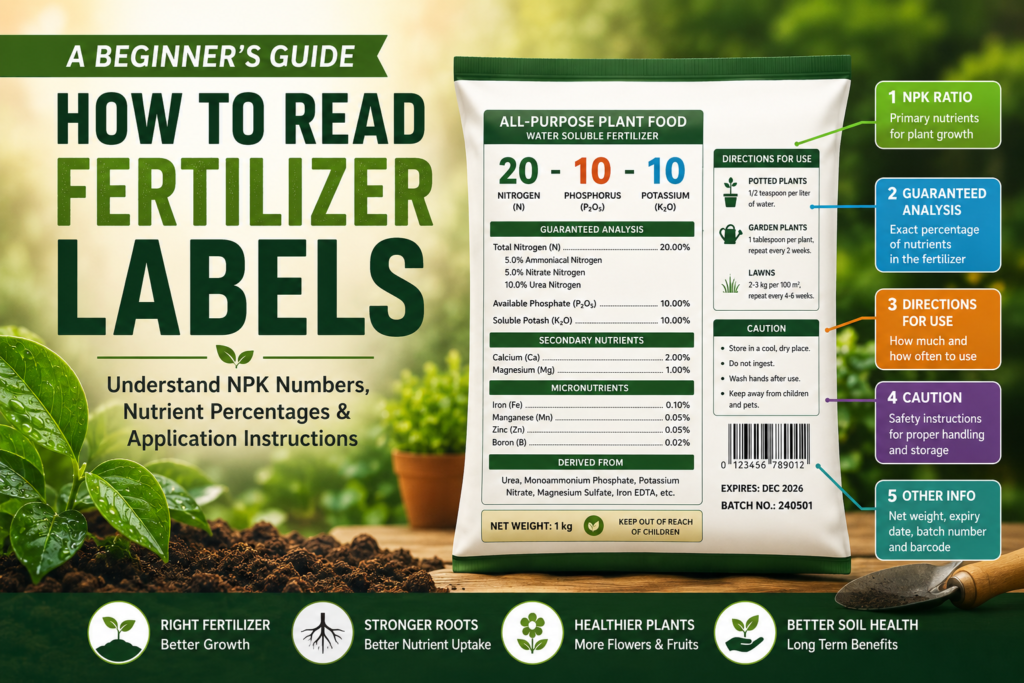
Jul
Learn how to read fertilizer labels with confidence. Understand NPK numbers, guaranteed analysis, secondary nutrients, micronutrients, dosage instructions, and choose the right fertilizer for healthier plants and better harvests.
AI Quick Answer
Fertilizer labels provide important information about the nutrients, ingredients, application rates, and safety instructions of a fertilizer. The three numbers displayed on most fertilizers represent the percentage of Nitrogen (N), Phosphorus (P), and Potassium (K). Besides NPK, labels also mention secondary nutrients, micronutrients, guaranteed analysis, recommended dosage, and suitable crops. Learning to read fertilizer labels correctly helps gardeners choose the right product, avoid nutrient deficiencies, prevent over-fertilization, and improve overall plant health.
Key Takeaways
- Fertilizer labels explain exactly what nutrients are inside the product.
- The three numbers represent Nitrogen (N), Phosphorus (P), and Potassium (K).
- A higher NPK value does not always mean a fertilizer is better.
- Always read the application instructions before using any fertilizer.
- Secondary nutrients and micronutrients are just as important as NPK.
- Understanding fertilizer labels helps prevent overfeeding and nutrient imbalance.
- Organic fertilizers improve soil health while synthetic fertilizers usually provide faster nutrient availability.
Table of Contents
- What Is a Fertilizer Label?
- Why Reading Fertilizer Labels Matters
- Parts of a Fertilizer Label
- How to Read Fertilizer Labels: Understanding NPK Numbers
- Primary Nutrients Explained
- Secondary Nutrients
- Micronutrients
- Guaranteed Analysis
- Organic vs Chemical Fertilizer Labels
- Choosing the Right Fertilizer
- Common Label Terms
- Common Mistakes
- Recommended GreenKheti Products
- Frequently Asked Questions
- Conclusion
Why Understanding Fertilizer Labels Is Important
Buying a fertilizer can be confusing, especially if you are new to gardening. Bags and bottles often display numbers like 19-19-19, 10-26-26, or 13-00-45, along with technical terms such as Guaranteed Analysis, Chelated Micronutrients, or Water Soluble Potash. Without understanding these terms, many gardeners end up buying products that do not match their plants' actual needs.
Fortunately, reading a fertilizer label is much simpler than it appears. Once you understand what each section means, you'll be able to choose fertilizers more confidently, apply them correctly, avoid nutrient deficiencies, and prevent problems caused by over-fertilization.
Whether you grow vegetables, flowering plants, fruit trees, herbs, indoor plants, or ornamental gardens, learning to interpret fertilizer labels is one of the most valuable gardening skills you can develop.
What Is a Fertilizer Label?
A fertilizer label is an official information panel printed on the packaging that explains what nutrients the product contains, how much of each nutrient is available, how it should be used, and important safety or storage instructions.
It acts as a guide for gardeners, helping them understand whether a fertilizer is suitable for leafy vegetables, flowering plants, fruit crops, lawns, indoor plants, or soil improvement.
Never purchase a fertilizer based only on the front label or marketing claims. Always read the nutrient composition, recommended dosage, and application instructions printed on the package before making your decision.
Why Reading Fertilizer Labels Matters
Understanding fertilizer labels helps you make informed gardening decisions instead of relying on guesswork. Plants require different nutrients at different growth stages, and the right fertilizer can significantly improve growth, flowering, fruit production, and overall plant health.
| Benefit | How It Helps |
|---|---|
| Select the right fertilizer | Choose nutrients based on your plant's specific needs. |
| Prevent over-fertilization | Following the recommended dosage reduces the risk of root burn and nutrient toxicity. |
| Save money | Avoid buying products that provide unnecessary nutrients. |
| Improve plant health | Balanced nutrition supports stronger roots, healthier foliage, flowers, and fruits. |
| Protect the environment | Correct application reduces nutrient runoff into surrounding soil and water. |
Read Fertilizer Labels Step by Step
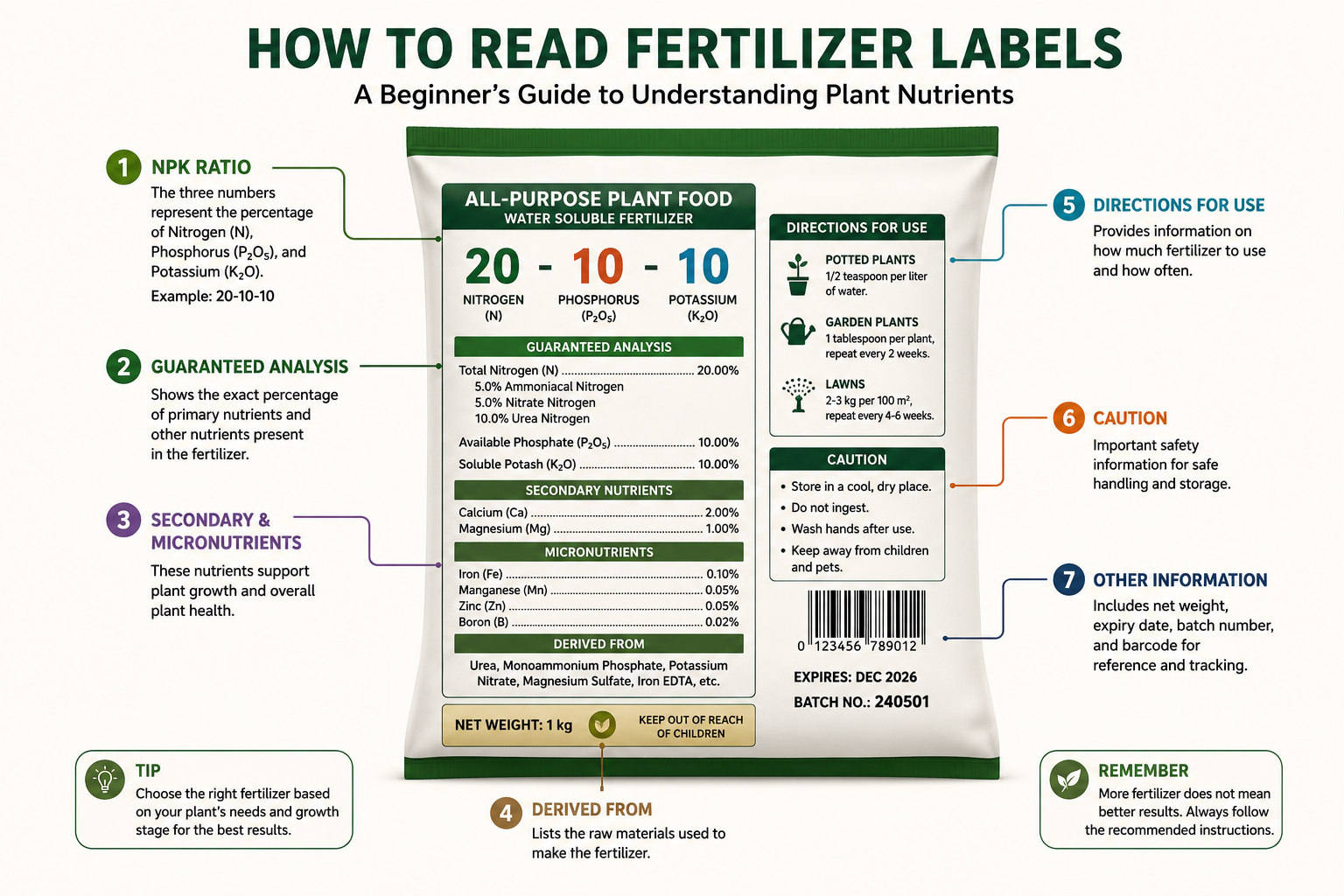
Although the design may differ between brands, most fertilizer labels contain similar information. Knowing what each section represents makes comparing different fertilizers much easier.
| Label Section | Purpose |
|---|---|
| Product Name | Identifies the fertilizer and its intended purpose. |
| NPK Grade | Shows the percentage of Nitrogen, Phosphorus, and Potassium. |
| Guaranteed Analysis | Lists every nutrient contained in the fertilizer. |
| Ingredients | Explains where the nutrients come from. |
| Application Instructions | Provides dosage, frequency, and recommended method of use. |
| Suitable Plants | Specifies crops or ornamental plants for which the fertilizer is recommended. |
| Storage & Safety | Guidelines for proper storage and safe handling. |
| Manufacturer Details | Includes company information, batch number, and manufacturing date. |
How to Read Fertilizer Labels: Understanding NPK Numbers
The most noticeable information on any fertilizer package is usually a set of three numbers separated by hyphens—for example, 10-10-10, 19-19-19, or 13-00-45. These numbers are called the fertilizer grade and represent the percentage by weight of the three primary plant nutrients:
- N = Nitrogen
- P = Phosphorus (reported as available phosphate)
- K = Potassium (reported as soluble potash)
Understanding these numbers is the first step toward selecting the right fertilizer for your plants. In the next section, we'll explore what each nutrient does, how to interpret different NPK ratios, and when to choose one formulation over another.
What Do the NPK Nutrients Actually Do?
Every healthy plant requires three primary nutrients in the largest quantities. These are Nitrogen (N), Phosphorus (P), and Potassium (K). While all three are essential, each nutrient supports different aspects of plant growth. Understanding their role helps you choose fertilizers that match your plant's current growth stage.
| Nutrient | Main Function | Signs of Deficiency | Best Growth Stage |
|---|---|---|---|
| Nitrogen (N) | Promotes leafy growth and chlorophyll production. | Yellow older leaves, slow growth. | Vegetative growth. |
| Phosphorus (P) | Supports strong roots, flowering and seed development. | Poor flowering, weak roots, purple leaves. | Root establishment and flowering. |
| Potassium (K) | Improves fruit quality, disease resistance and stress tolerance. | Brown leaf edges, weak stems, poor fruit quality. | Flowering and fruiting. |
How to Interpret Different NPK Ratios
Fertilizers with different NPK grades are designed for different purposes. A balanced fertilizer is not always the best choice. Select a fertilizer according to the growth stage and nutrient requirement of your plants.
| NPK Grade | Suitable For | Typical Use |
|---|---|---|
| 10-10-10 | General gardening | Balanced nutrition for most plants. |
| 19-19-19 | Vegetables and ornamentals | Fast, balanced growth. |
| 13-00-45 | Fruiting crops | Improves fruit size and quality. |
| 12-61-00 | Seedlings and transplants | Encourages strong root development. |
| 00-52-34 | Flowering plants | Supports flowering and fruit setting. |
A fertilizer with a higher NPK number is not automatically better. The best fertilizer is the one that matches your plant's nutritional requirements.
Secondary Nutrients Are Equally Important
Besides NPK, plants also require secondary nutrients in moderate quantities. These nutrients are essential for healthy cell development, photosynthesis, enzyme activity, and overall plant strength.
| Nutrient | Role in Plants | Common Deficiency Symptoms |
|---|---|---|
| Calcium (Ca) | Strengthens cell walls and new growth. | Blossom end rot, distorted leaves. |
| Magnesium (Mg) | Essential component of chlorophyll. | Yellowing between leaf veins. |
| Sulfur (S) | Supports protein formation and enzyme activity. | Pale green young leaves. |
Micronutrients Found on Fertilizer Labels
Micronutrients are needed in very small quantities, but they play a vital role in plant metabolism, photosynthesis, flowering, and disease resistance. Many premium fertilizers include these nutrients as part of their guaranteed analysis.
| Micronutrient | Main Function |
|---|---|
| Iron (Fe) | Chlorophyll production. |
| Zinc (Zn) | Growth hormones and enzyme activation. |
| Boron (B) | Flower and fruit development. |
| Manganese (Mn) | Photosynthesis. |
| Copper (Cu) | Enzyme function. |
| Molybdenum (Mo) | Nitrogen metabolism. |
| Chlorine (Cl) | Water regulation. |
| Nickel (Ni) | Seed germination and nitrogen use. |
What Is Guaranteed Analysis?
The Guaranteed Analysis section is one of the most important parts of any fertilizer label. It lists the exact percentage of nutrients present in the product, allowing gardeners to compare fertilizers accurately.
| Label Term | Meaning |
|---|---|
| Total Nitrogen | Total amount of nitrogen available. |
| Available Phosphate | Plant-available phosphorus. |
| Soluble Potash | Available potassium source. |
| Organic Matter | Improves soil structure and microbial activity. |
| Humic Acid | Enhances nutrient uptake and root growth. |
| Seaweed Extract | Provides natural plant growth compounds. |
| Beneficial Microorganisms | Support healthier soil biology. |
Don't choose a fertilizer solely based on the NPK numbers. Always review the Guaranteed Analysis to understand the complete nutrient profile, especially if your plants require calcium, magnesium, sulfur, or beneficial microbes.
Organic vs Chemical Fertilizer Labels
Fertilizer labels also indicate whether the nutrients come from natural organic sources or manufactured mineral sources. Understanding this distinction helps you select products based on your gardening goals, soil health, and crop type.
Organic vs Chemical Fertilizer Labels
One of the first things you'll notice on a fertilizer package is whether it is an organic fertilizer or a chemical (synthetic) fertilizer. Although both provide nutrients, they differ in their nutrient source, release speed, and long-term effect on soil health.
| Feature | Organic Fertilizers | Chemical Fertilizers |
|---|---|---|
| Nutrient Source | Plant, animal or mineral-based materials. | Manufactured mineral salts. |
| Nutrient Release | Slow and gradual. | Fast acting. |
| Soil Health | Improves soil structure and microbial activity. | Little effect on soil biology. |
| Risk of Overfeeding | Lower when used correctly. | Higher if dosage exceeds recommendations. |
| Best Use | Long-term soil improvement. | Quick correction of nutrient deficiencies. |
Many experienced gardeners combine both approaches—using organic fertilizers to build healthy soil and supplementing with water-soluble fertilizers only when plants need a quick nutrient boost.
Slow-Release vs Water-Soluble Fertilizers
Fertilizer labels often mention whether nutrients are slow-release or water-soluble. This tells you how quickly nutrients become available to plants.
| Slow-Release Fertilizer | Water-Soluble Fertilizer |
|---|---|
| Gradually releases nutrients. | Nutrients become available immediately. |
| Requires fewer applications. | Needs regular application. |
| Lower risk of nutrient burn. | Incorrect dosage may damage roots. |
| Ideal for long-term feeding. | Ideal for correcting deficiencies quickly. |
Common Mistakes When Learning How to Read Fertilizer Labels
- Choosing fertilizers only because they have higher NPK values.
- Ignoring the recommended application rate.
- Not checking whether the fertilizer is suitable for your crop.
- Overlooking secondary nutrients like calcium and magnesium.
- Ignoring micronutrients in nutrient-deficient soils.
- Applying fertilizers more frequently than recommended.
- Mixing incompatible fertilizers without proper guidance.
Over-fertilizing can damage roots, reduce flowering, increase salt buildup in the soil, and even kill plants. Always follow the dosage mentioned on the fertilizer label.
How to Read a Fertilizer Label Step by Step
Fertilizer labels may look complicated, but they usually follow the same layout. Once you understand each section, you can compare products confidently and choose the right fertilizer for your plants.
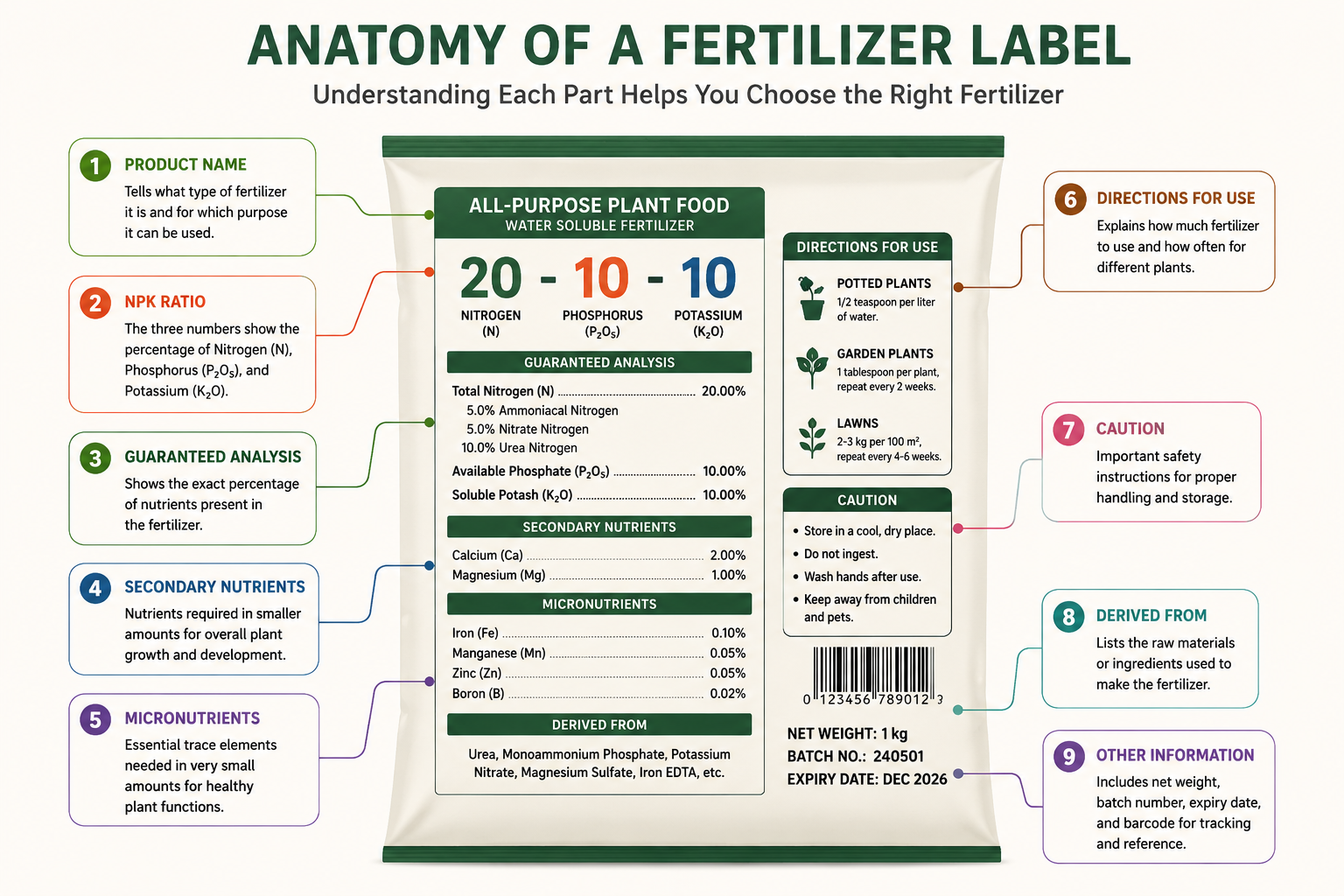
| Label Area | What to Check | Why It Matters |
|---|---|---|
| Product Name | Purpose of fertilizer | Shows whether it is designed for vegetables, flowers, lawns, fruits or soil improvement. |
| NPK Grade | Three nutrient numbers | Shows primary nutrient percentage. |
| Guaranteed Analysis | Complete nutrient profile | Shows secondary nutrients and micronutrients. |
| Application Rate | Dosage | Prevents over-fertilization. |
| Suitable Crops | Recommended plants | Ensures the fertilizer matches your crop. |
| Manufacturing Details | Date and batch number | Useful for freshness and quality assurance. |
10 Popular Fertilizer Labels Explained with Examples
Below are some of the most commonly available fertilizers in India and what their labels actually tell you.
Example 1 — 19:19:19 NPK Fertilizer
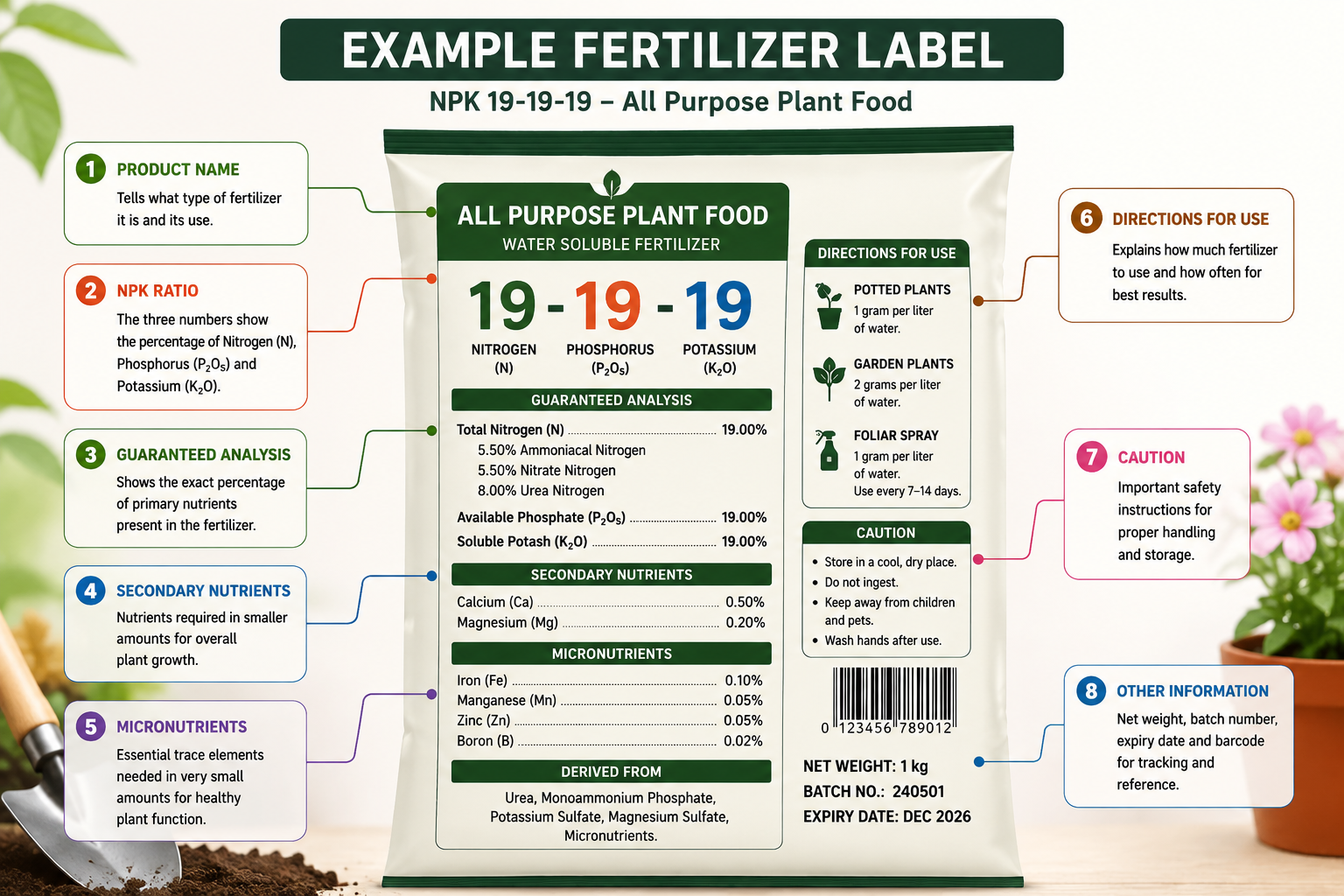
- Meaning: 19% Nitrogen, 19% Phosphorus, 19% Potassium
- Best For: General plant growth
- Suitable Plants: Vegetables, flowers, ornamental plants
- Growth Stage: Vegetative growth
- Why Choose: Balanced nutrition for most garden plants.
Example 2 — Urea (46-0-0)
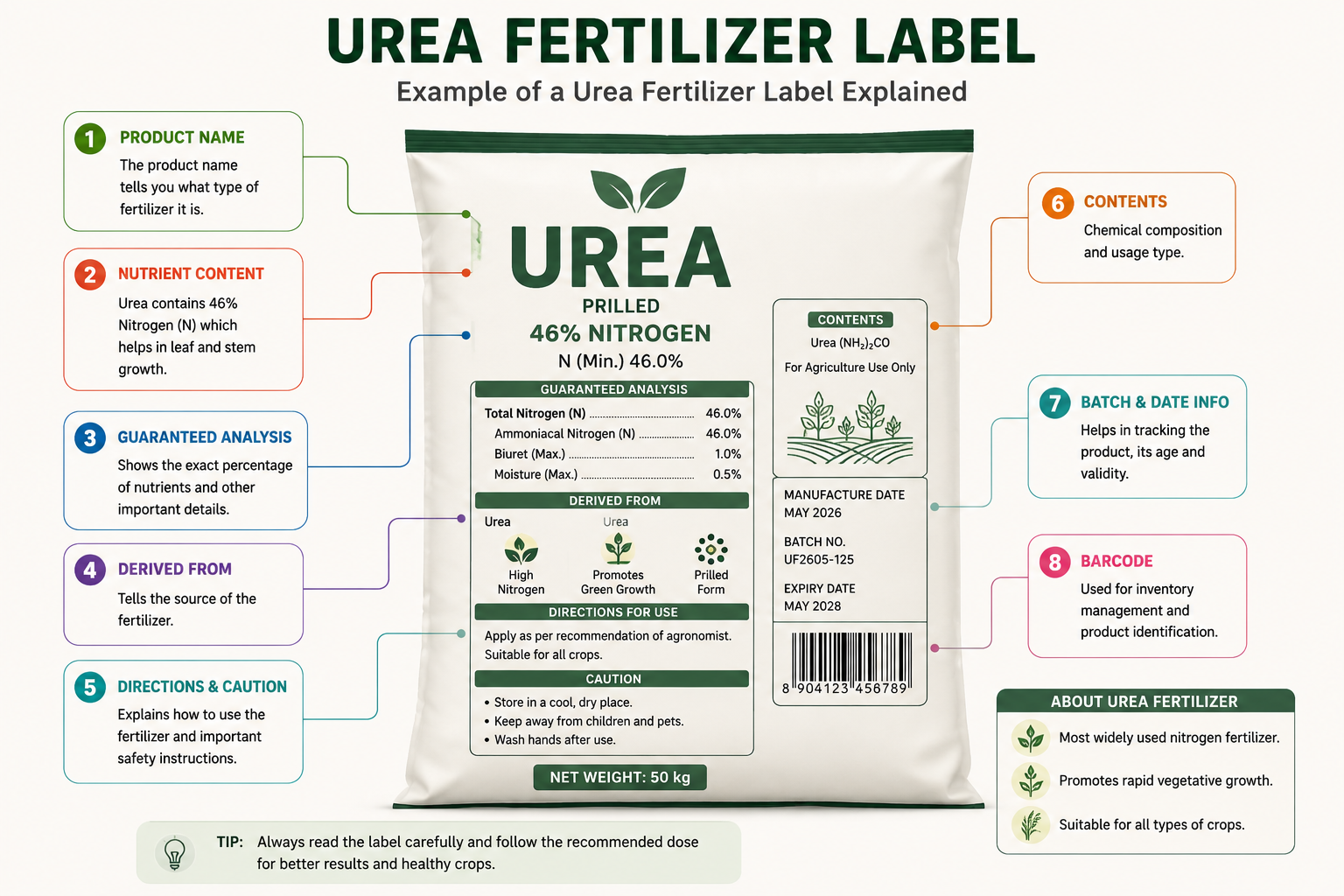
- Nitrogen: 46%
- Phosphorus: 0%
- Potassium: 0%
- Purpose: Rapid leafy growth
- Use Carefully: Excess application may burn plants.
Example 3 — DAP (18-46-0)
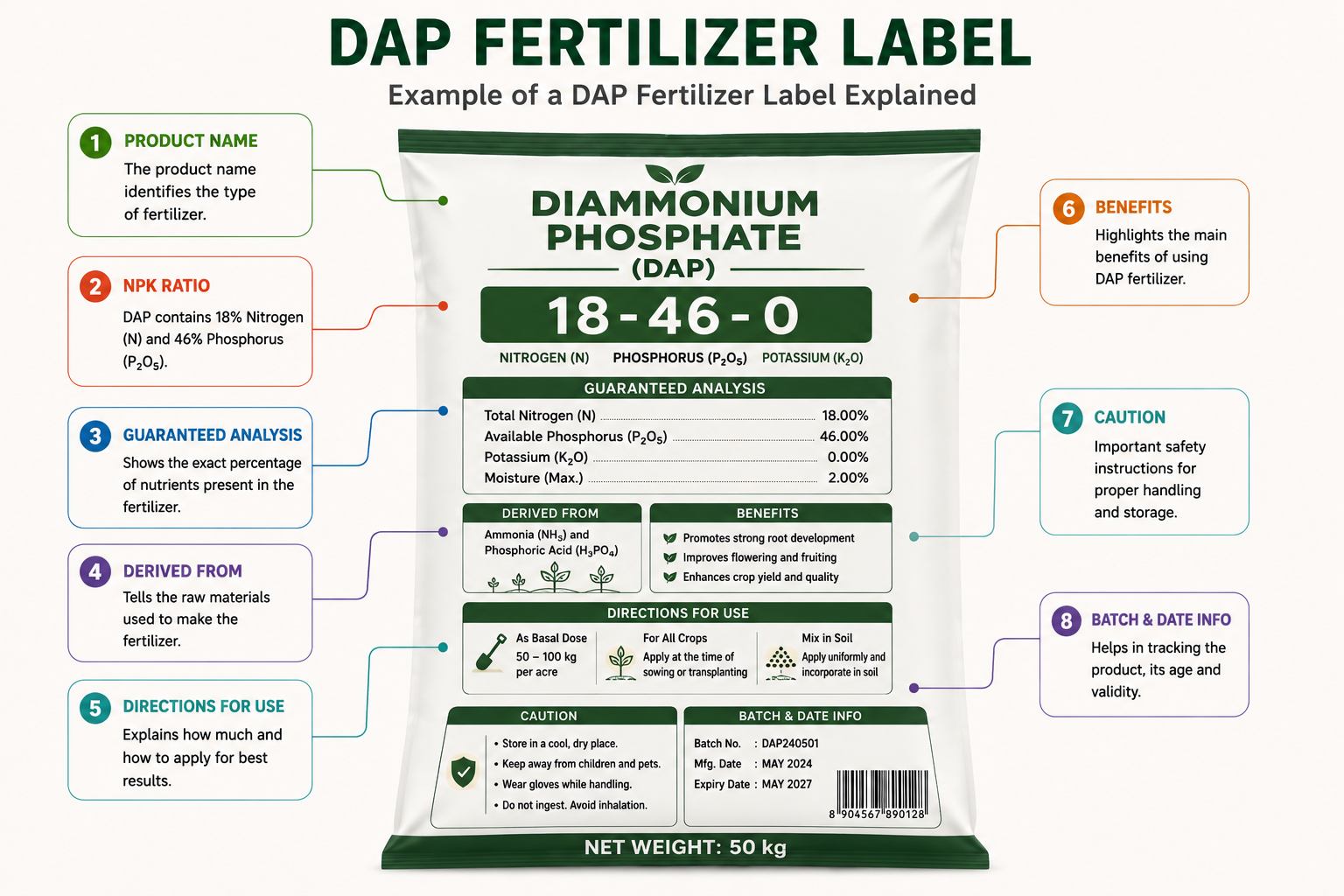
- 18% Nitrogen
- 46% Phosphorus
- Excellent for root establishment
- Useful during early crop growth
Example 4 — MOP (0-0-60)
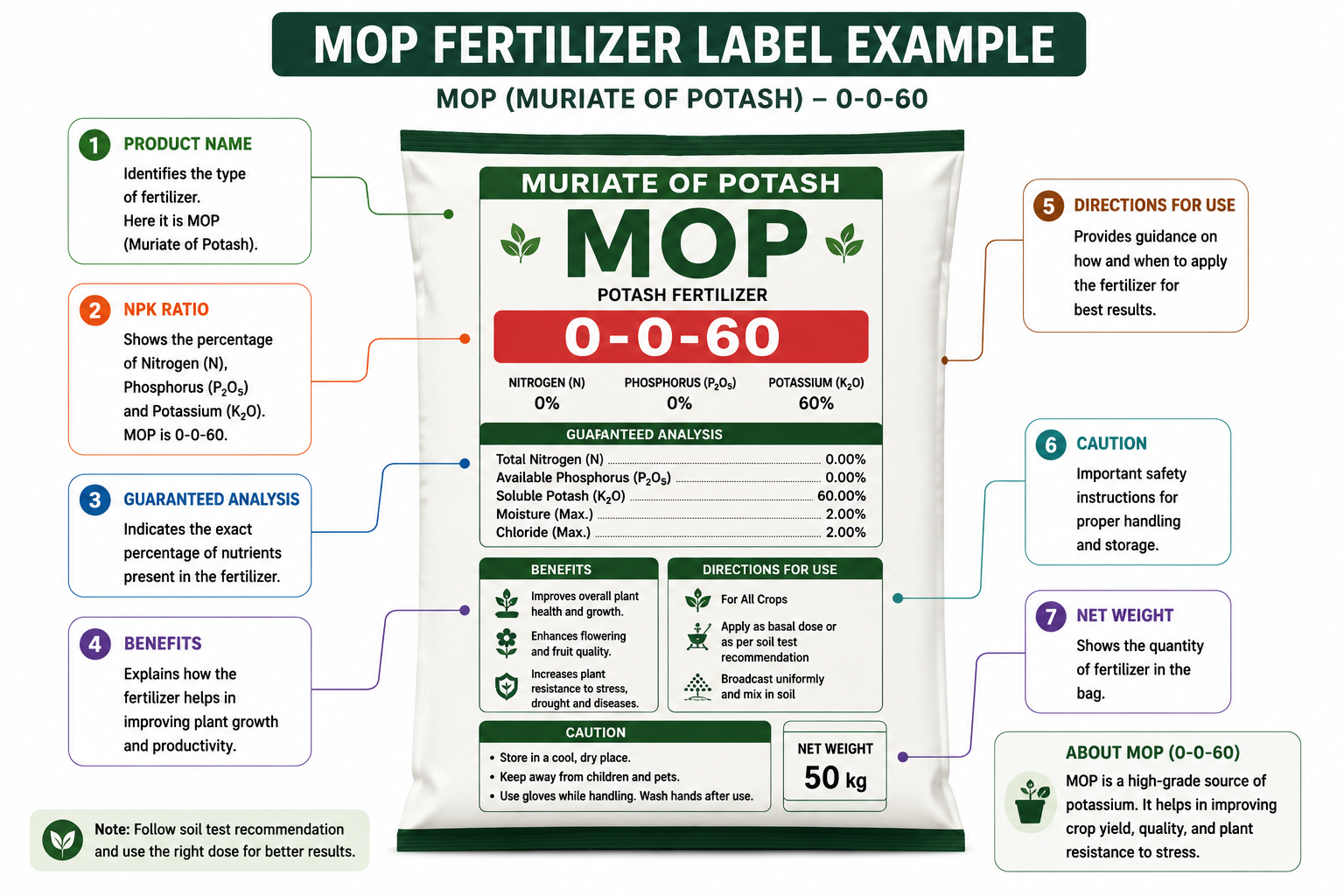
- Very high potassium
- Improves fruit quality
- Enhances disease resistance
- Suitable for fruiting crops
Example 5 — Bone Meal
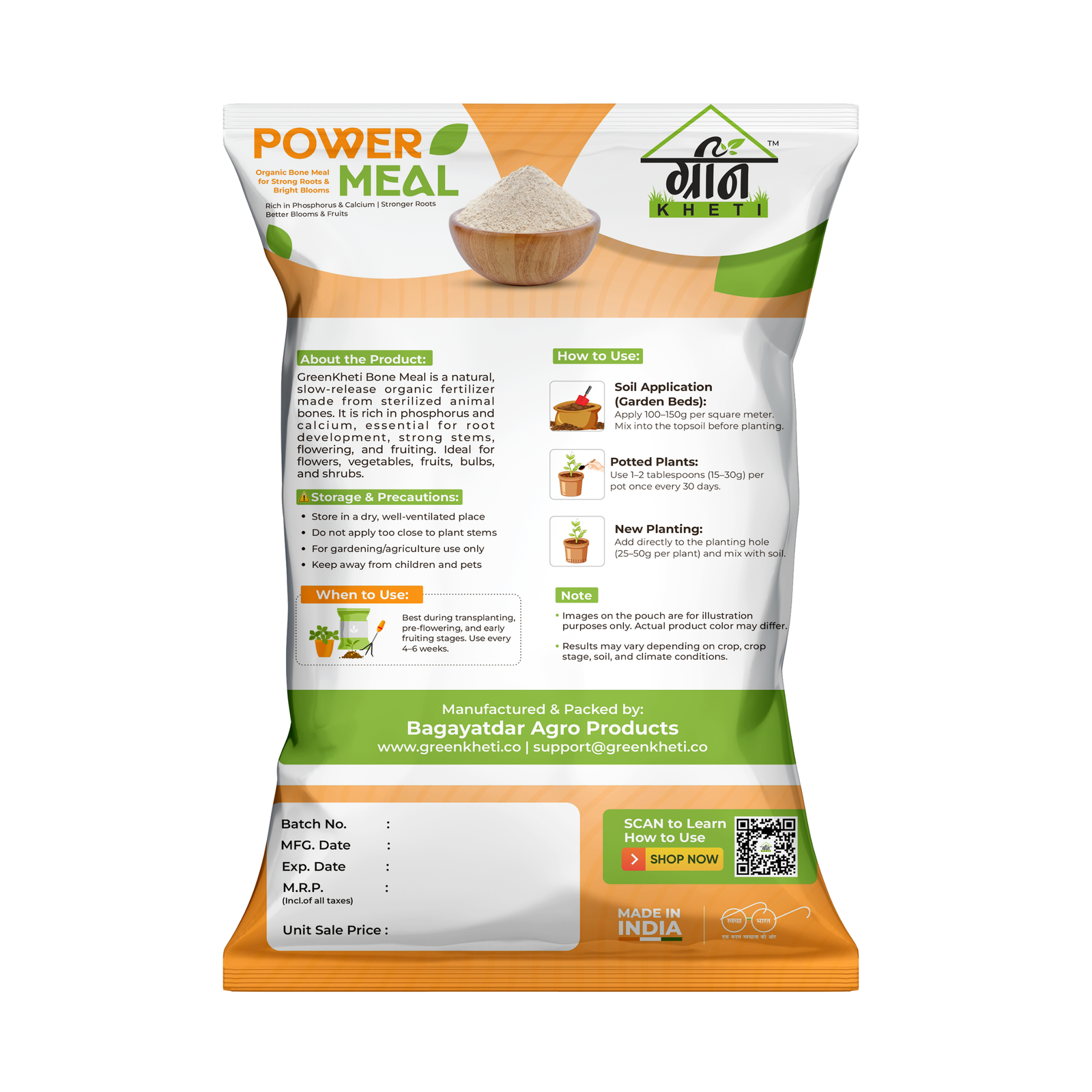
- Organic fertilizer
- Rich in phosphorus
- Excellent for bulbs, roses and flowering plants
- Slow nutrient release
Example 6 — Neem Cake
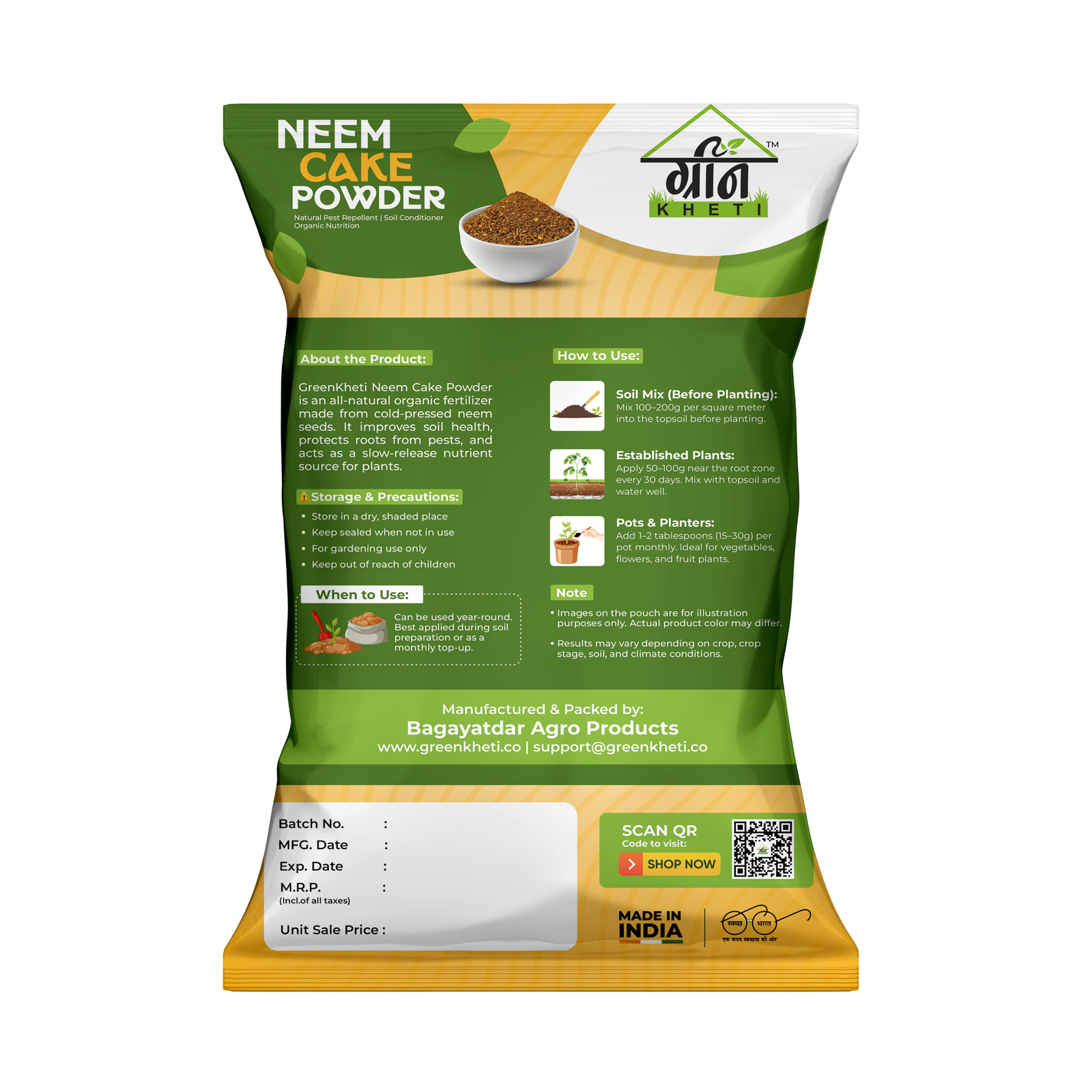
- Organic soil conditioner
- Improves soil biology
- Helps reduce certain soil pests
- Supports long-term soil fertility
Example 7 — Seaweed Extract
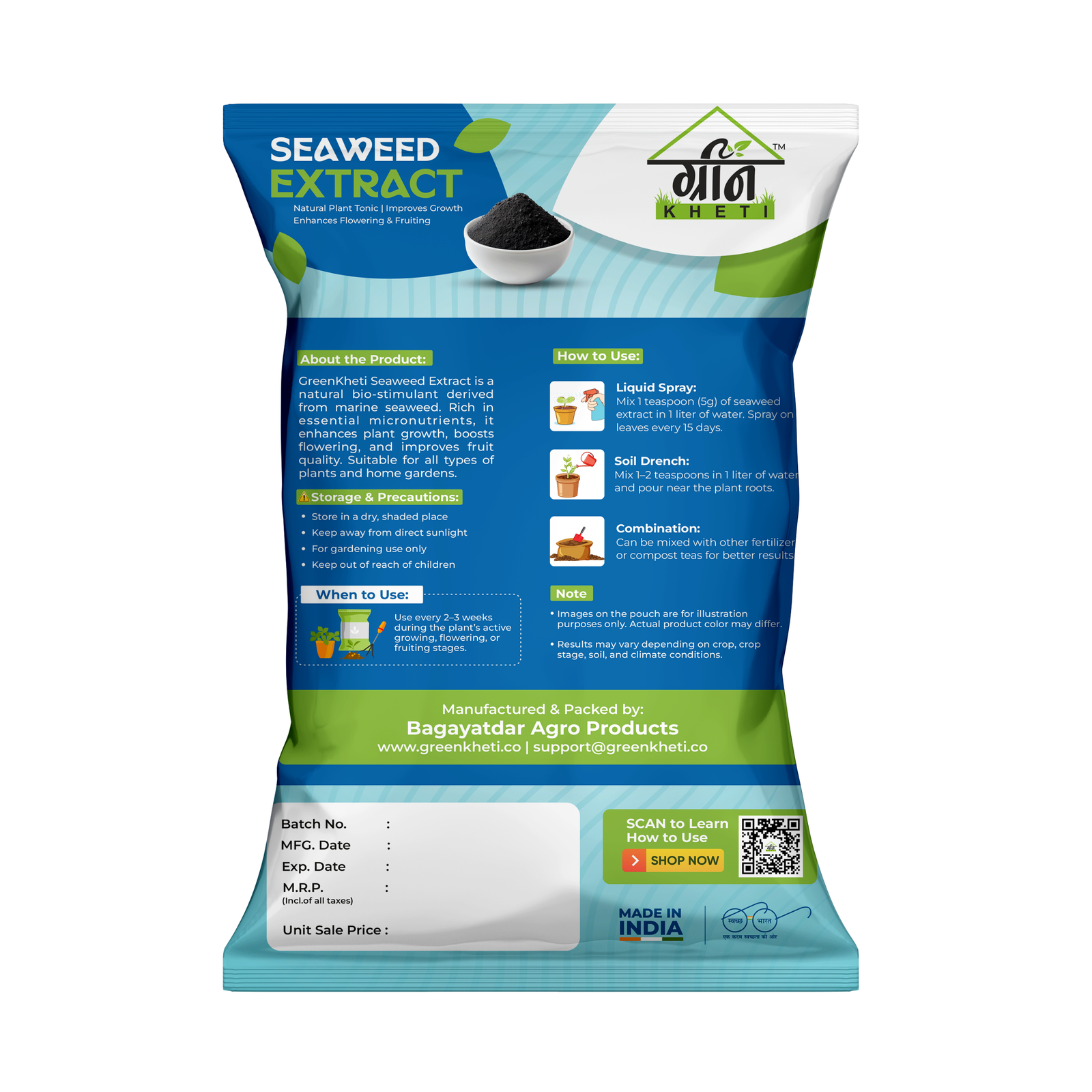
- Natural biostimulant
- Usually contains very low NPK
- Improves stress tolerance
- Encourages vigorous growth
Example 8 — Humic Acid
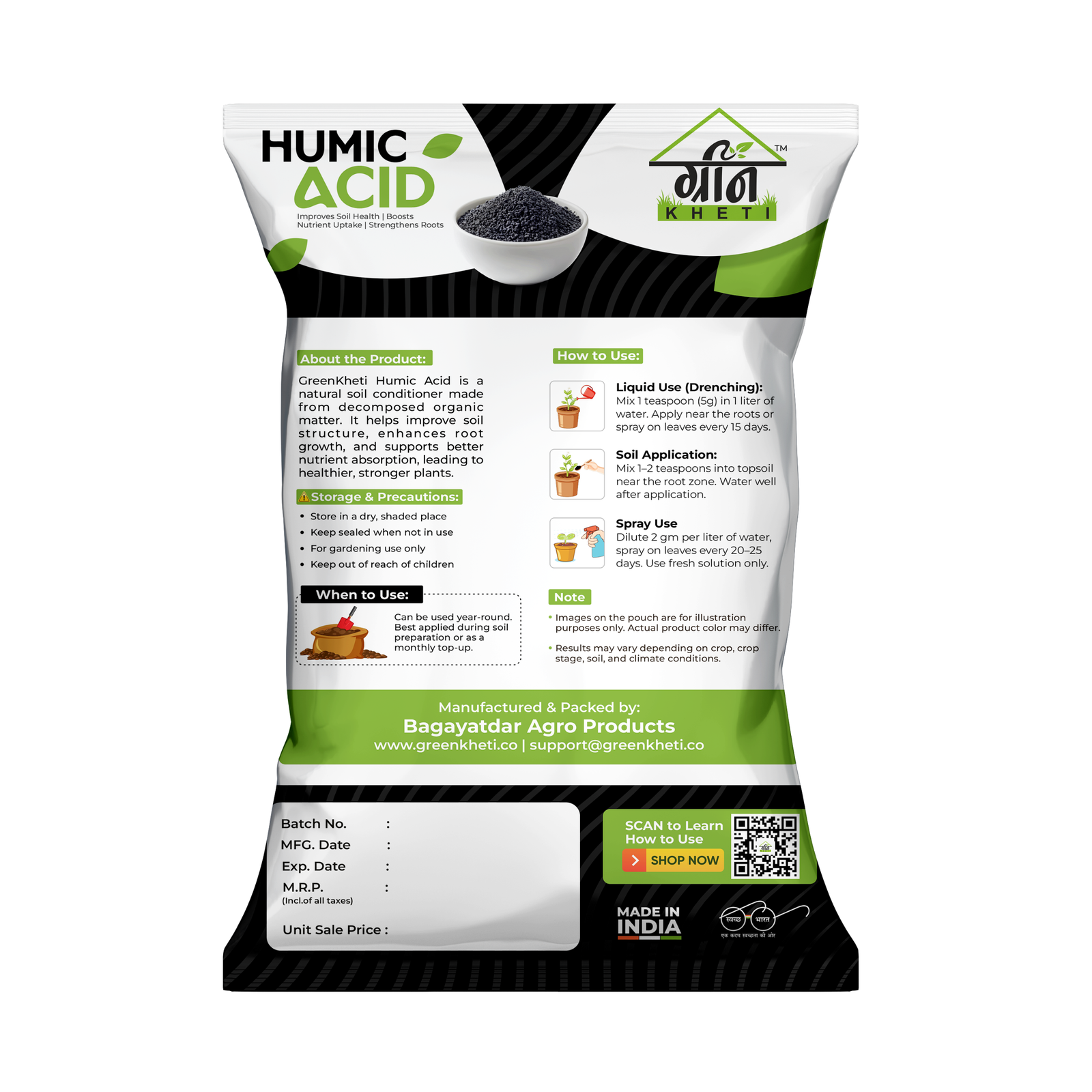
- Acts mainly as a soil conditioner
- Improves nutrient uptake
- Promotes root development
- Enhances soil microbial activity
Example 9 — Epsom Salt (Magnesium Sulfate)
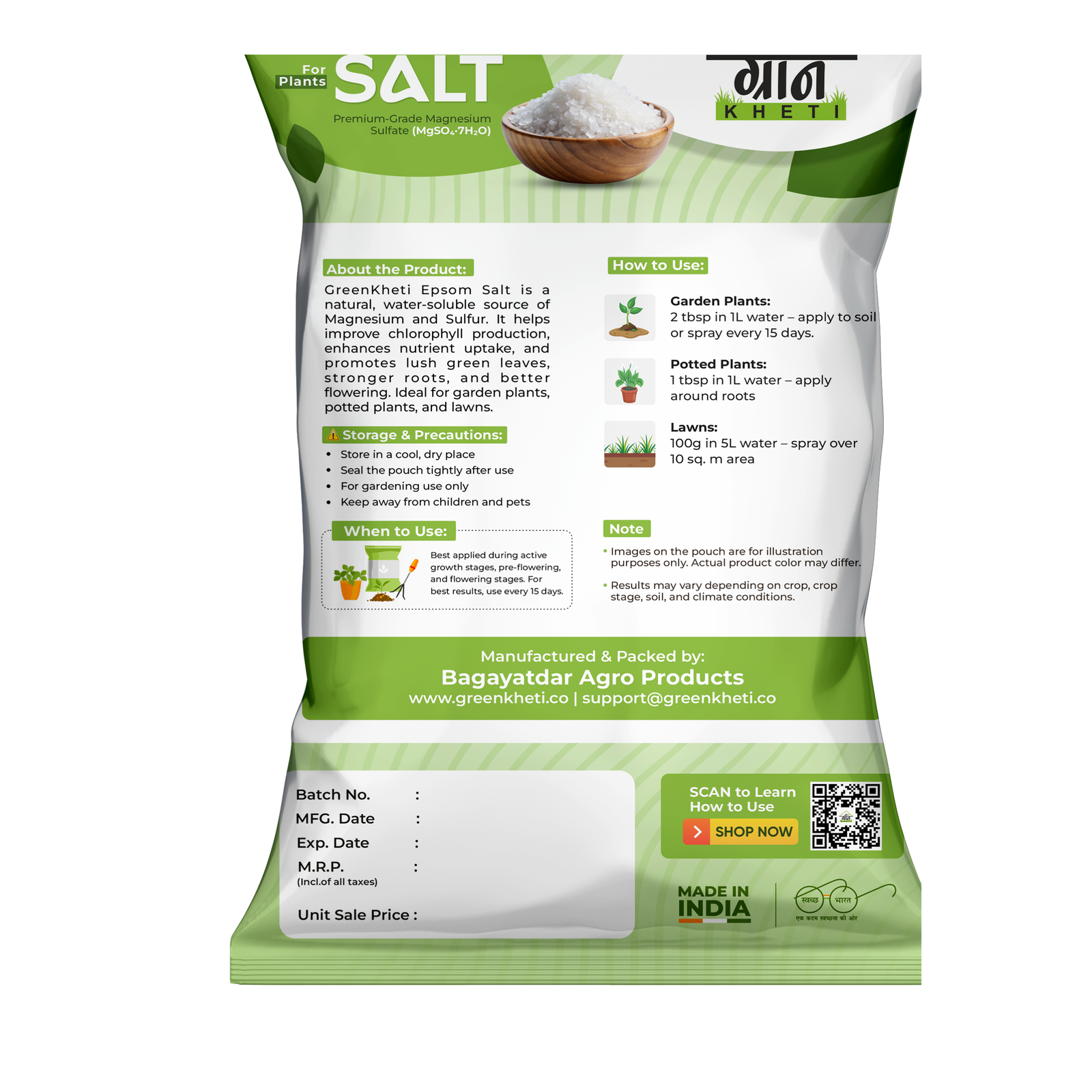
- Provides magnesium and sulfur
- Corrects magnesium deficiency
- Supports chlorophyll production
- Useful when leaves show interveinal yellowing
Example 10 — Mycorrhiza Biofertilizer
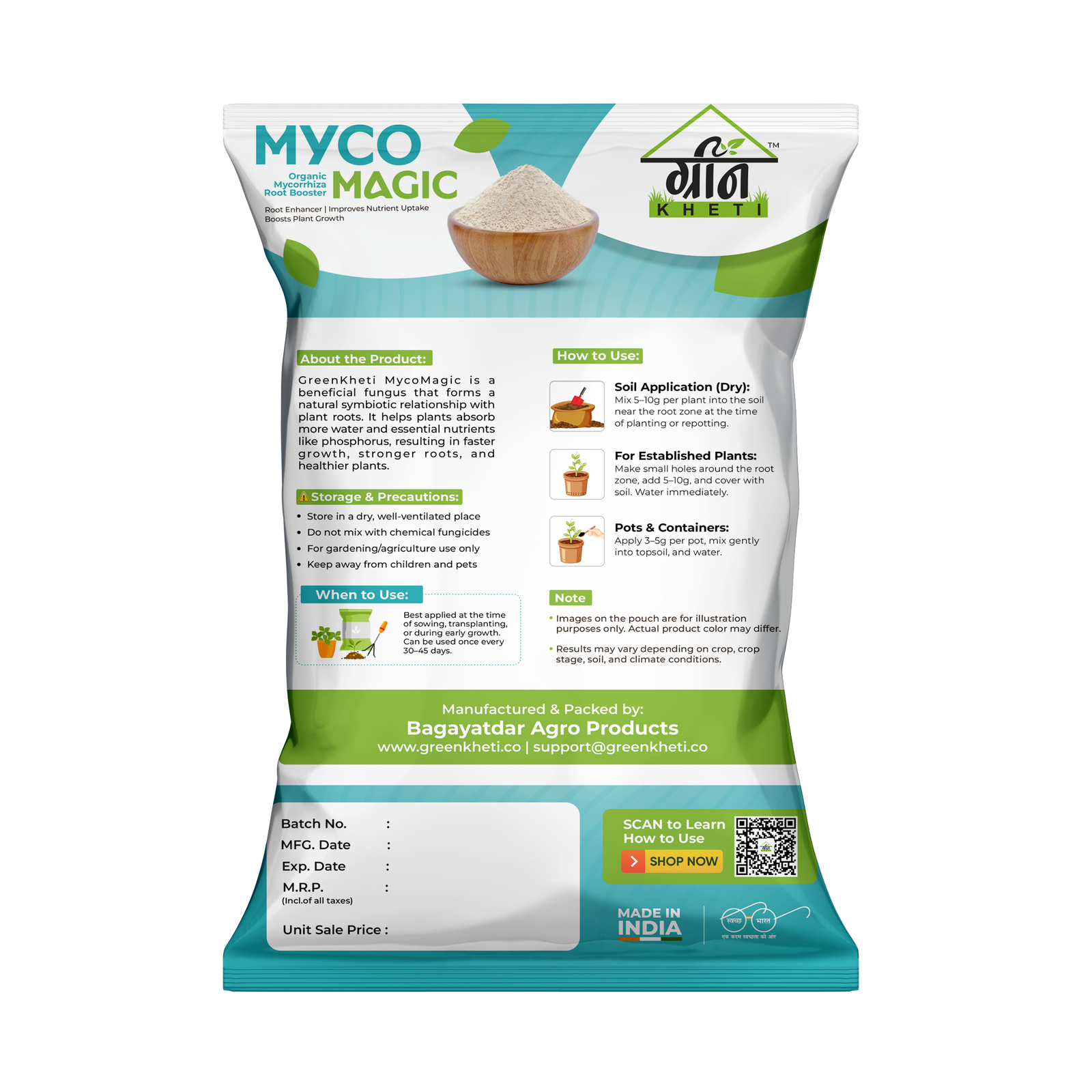
- Contains beneficial fungi
- May display CFU or spore count instead of NPK
- Improves root surface area
- Enhances water and nutrient absorption
Quick Fertilizer Selection Table
| Plant Problem | Nutrient to Look For | Example Fertilizer |
|---|---|---|
| Yellow leaves | Nitrogen / Magnesium | Urea, Epsom Salt |
| Poor flowering | Higher Phosphorus | Bone Meal, Flower Booster |
| Poor fruit quality | Higher Potassium | MOP, Fruit Booster |
| Weak roots | Phosphorus | DAP, Bone Meal |
| Slow growth | Balanced NPK | 19-19-19 |
| Soil improvement | Organic Matter | Neem Cake, Compost, Humic Acid |
| Stress recovery | Biostimulants | Seaweed Extract |
| Improve nutrient uptake | Beneficial Microbes | Mycorrhiza |
Recommended Fertilizers for Common Vegetables
| Vegetable | Best Fertilizer | Growth Stage |
|---|---|---|
| Tomato | Balanced NPK → Potassium | Flowering & Fruiting |
| Brinjal | Balanced NPK | Entire Growth |
| Spinach | Nitrogen-rich | Leaf Development |
| Cabbage | Nitrogen + Calcium | Vegetative Growth |
| Okra | Balanced Nutrition | Entire Growth |
| Cucumber | Balanced + Potassium | Flowering |
Recommended Fertilizers for Flowering Plants
| Plant | Recommended Nutrients | Purpose |
|---|---|---|
| Rose | High Phosphorus | More Blooms |
| Hibiscus | Balanced + Potassium | Continuous Flowering |
| Jasmine | Organic + Phosphorus | Healthy Flowers |
| Marigold | Balanced NPK | Abundant Blooming |
| Bougainvillea | Low Nitrogen | Better Flower Production |
Recommended Fertilizers for Fruit Plants
| Fruit Plant | Recommended Nutrients | Benefit |
|---|---|---|
| Mango | Potassium-rich | Fruit Quality |
| Guava | Balanced Nutrition | Healthy Growth |
| Lemon | Nitrogen + Potassium | Flowering & Fruiting |
| Pomegranate | Balanced + Potassium | Fruit Size |
| Papaya | Balanced NPK | Continuous Production |
Recommended Fertilizers for Indoor Plants
| Indoor Plant | Recommended Fertilizer | Application Frequency |
|---|---|---|
| Money Plant | Balanced Organic Fertilizer | Every 30 Days |
| Snake Plant | Mild Balanced Fertilizer | Every 45–60 Days |
| Peace Lily | Balanced NPK | Monthly |
| Spider Plant | Organic Compost | Monthly |
| ZZ Plant | Diluted Balanced Fertilizer | Every 2 Months |
Common Misconceptions About Fertilizer Labels
- ❌ Higher NPK numbers always mean better fertilizer.
- ❌ Organic fertilizers do not contain nutrients.
- ❌ More fertilizer always means faster growth.
- ❌ All plants need the same fertilizer.
- ❌ Micronutrients are not important.
- ❌ Fertilizer can replace healthy soil.
- ❌ Plants need fertilizer every week.
- ❌ Any fertilizer works for every season.
- ❌ Liquid fertilizers are always better than granular fertilizers.
- ❌ Yellow leaves always mean nitrogen deficiency.
Checklist Before Buying Any Fertilizer
- ✔ Read the NPK grade.
- ✔ Check the Guaranteed Analysis.
- ✔ Verify whether it is organic or synthetic.
- ✔ Read the dosage instructions.
- ✔ Check suitable crops.
- ✔ Verify manufacturing and expiry dates.
- ✔ Compare nutrient percentages.
- ✔ Check for micronutrients.
- ✔ Buy according to your plant's growth stage.
- ✔ Store the fertilizer correctly after purchase.
GreenKheti Expert Tips
- Always identify the plant problem before choosing a fertilizer.
- Read the entire fertilizer label—not just the NPK numbers.
- Healthy soil often requires organic matter in addition to nutrients.
- Choose fertilizers based on the plant's growth stage rather than popularity.
- Store fertilizers in a cool, dry place away from moisture.
- Measure fertilizers accurately using the recommended dosage.
Recommended GreenKheti Products
Depending on your plants' nutritional needs, the following GreenKheti products can help improve soil health, nutrient availability, flowering, fruiting, and overall plant growth.
| Product | Best For | Website | Amazon |
|---|---|---|---|
| GreenKheti Humic Acid | Improves nutrient uptake and root growth. | Website | Amazon |
| GreenKheti Seaweed Extract | Supports stress recovery and healthy growth. | Website | Amazon |
| GreenKheti MycoMagic Mycorrhiza | Enhances root development and nutrient absorption. | Website | Amazon |
| GreenKheti Neem Cake Powder | Improves soil fertility and supports healthy root zones. | Website | Amazon |
| GreenKheti Flower Booster | Encourages abundant flowering. | Website | Amazon |
Need Help Choosing the Right Fertilizer?
Still confused after reading the fertilizer label? The GreenKheti AI Plant Care WhatsApp Bot can help you understand fertilizer labels, identify plant nutrient deficiencies, recommend suitable fertilizers, and answer your gardening questions.
Simply send a photo of your fertilizer label or your plant, and the AI assistant will guide you step by step.
Frequently Asked Questions
1. What do the three numbers on a fertilizer label mean?
They represent the percentage of Nitrogen (N), Phosphorus (P), and Potassium (K), the three primary nutrients required for healthy plant growth.
2. Does a higher NPK number mean a better fertilizer?
No. The best fertilizer depends on your plant's nutritional needs, growth stage, and soil condition—not the highest numbers.
3. What is Guaranteed Analysis?
It is the section that lists the exact percentage of nutrients contained in the fertilizer.
4. Why are secondary nutrients important?
Nutrients like calcium, magnesium, and sulfur support healthy leaves, strong stems, root development, and overall plant growth.
5. What are micronutrients?
Micronutrients such as iron, zinc, boron, copper, and manganese are required in small quantities but are essential for plant health.
6. Can organic fertilizers also have NPK values?
Yes. Organic fertilizers contain NPK nutrients, although their nutrient percentages are usually lower than synthetic fertilizers.
7. What is a slow-release fertilizer?
Slow-release fertilizers gradually supply nutrients over an extended period, reducing nutrient loss and minimizing the risk of over-fertilization.
8. What is a water-soluble fertilizer?
Water-soluble fertilizers dissolve completely in water, allowing plants to absorb nutrients quickly through roots or foliage.
9. How often should fertilizer be applied?
Follow the manufacturer's instructions. Application frequency varies depending on the fertilizer type, crop, season, and growing conditions.
10. Can I mix different fertilizers together?
Some fertilizers are compatible, while others are not. Always read product instructions before mixing different fertilizers.
11. What happens if I over-fertilize my plants?
Excess fertilizer can burn roots, damage leaves, reduce flowering, and create nutrient imbalances in the soil.
12. Should I always buy fertilizers with the highest NPK values?
No. Higher nutrient percentages are not always beneficial. Plants perform best when nutrients match their actual requirements.
13. Why should I check the manufacturing date?
Fresh products generally provide better quality, especially biological fertilizers that contain beneficial microorganisms.
14. Can fertilizer labels help identify the right product for flowering plants?
Yes. Labels indicate nutrient composition, helping gardeners choose fertilizers that support flowering, fruiting, or vegetative growth.
15. How can beginners choose the right fertilizer?
Identify your plant's growth stage, read the fertilizer label carefully, compare nutrient content, and follow the recommended application rate.
Conclusion
Reading fertilizer labels may seem complicated at first, but once you understand the meaning of NPK numbers, Guaranteed Analysis, nutrient sources, and application instructions, selecting the right fertilizer becomes much easier.
Rather than choosing a product based solely on high nutrient percentages, focus on your plant's growth stage, soil condition, and nutritional requirements. This approach helps improve plant health, reduces fertilizer waste, and promotes sustainable gardening.
Whether you're growing vegetables, flowering plants, fruit trees, herbs, or indoor plants, taking a few minutes to read the fertilizer label can make a significant difference in achieving healthier growth and better harvests.
Continue Reading
References
