

Gardening Tips
How to Improve Soil Fertility Naturally: A Complete Guide for Healthy Plants
Jul
Discover proven natural methods to improve soil fertility using compost, organic matter, cover crops, biofertilizers, and beneficial microbes for healthier plants and higher yields.
AI Quick Answer
The best way to improve soil fertility naturally is by increasing organic matter, encouraging beneficial soil microbes, and supplying balanced nutrients over time. Compost, vermicompost, neem cake, green manure, crop rotation, mulching, biofertilizers, mycorrhiza, seaweed extract, and humic acid all help create fertile, biologically active soil. Instead of relying only on chemical fertilizers, improving soil structure and microbial life allows plants to absorb nutrients more efficiently, retain moisture longer, and develop stronger root systems.
Key Takeaways
- Healthy soil is the foundation of healthy plants.
- Organic matter is the single biggest contributor to long-term soil fertility.
- Beneficial microbes play a major role in nutrient availability.
- Soil fertility improves gradually, not overnight.
- Mulching reduces nutrient loss and conserves moisture.
- Crop rotation naturally prevents nutrient depletion.
- Biofertilizers improve nutrient availability without harming soil biology.
- Healthy soil reduces the need for excessive fertilizer applications.
Table of Contents
How to Improve Soil Fertility Naturally
Healthy plants begin with healthy soil. Whether you grow vegetables, flowering plants, fruit trees, herbs, or indoor plants, soil fertility directly influences root development, nutrient absorption, flowering, fruit production, and resistance to pests and diseases. Even the highest-quality fertilizer cannot compensate for poor soil that lacks organic matter, beneficial microorganisms, or proper structure.
Many gardeners focus only on adding fertilizers whenever plants appear weak. While fertilizers provide essential nutrients, they are only one part of a much larger system. Truly fertile soil contains billions of microorganisms, earthworms, fungi, organic matter, air spaces, moisture, and balanced nutrients working together to support plant growth naturally.
Modern gardening often relies heavily on synthetic fertilizers to achieve quick results. Although these products can temporarily increase plant growth, continuous dependence on them without improving soil biology may gradually reduce organic matter, microbial diversity, and overall soil quality. Over time, compacted and biologically inactive soil becomes less productive, requiring increasingly frequent fertilizer applications.
Improving soil fertility naturally takes a different approach. Instead of feeding only the plant, natural soil management focuses on feeding the entire soil ecosystem. Compost, mulch, biofertilizers, cover crops, earthworms, and beneficial fungi all contribute to building living soil that continues supplying nutrients year after year.
In this comprehensive guide, you'll learn practical, science-backed techniques to improve soil fertility naturally, understand why fertile soil produces healthier plants, and discover long-term strategies that reduce fertilizer dependency while improving crop quality and soil sustainability.
What Is Soil Fertility?
Soil fertility refers to the soil's ability to supply plants with the essential nutrients, water, oxygen, and biological activity required for healthy growth. Fertile soil supports strong root systems, steady plant development, abundant flowering, and high-quality harvests without excessive external inputs.
A fertile soil is not simply rich in nutrients. It also has good structure, proper drainage, balanced pH, active microbial populations, and sufficient organic matter to hold nutrients in forms that plants can absorb.
Healthy soil acts as a living ecosystem—not just a growing medium.
Soil Fertility vs Soil Health
Although these terms are often used interchangeably, soil fertility and soil health are not exactly the same. Soil fertility focuses mainly on nutrient availability, whereas soil health includes the physical, chemical, and biological condition of the soil.
| Soil Fertility | Soil Health |
|---|---|
| Focuses on nutrient availability. | Includes physical, chemical, and biological properties. |
| Supports plant nutrition. | Supports the entire soil ecosystem. |
| Can be temporarily increased with fertilizers. | Improves gradually through sustainable practices. |
| Measures nutrient supply. | Measures long-term soil productivity. |
| One part of healthy soil. | Represents overall soil quality. |
Why Soil Fertility Matters
Plants require seventeen essential nutrients to complete their life cycle. If even one essential nutrient becomes unavailable, plant growth slows regardless of how much of the other nutrients are present. Fertile soil acts as a natural reservoir, continuously supplying these nutrients while maintaining proper moisture and air circulation around roots.
- Supports healthy root development.
- Improves nutrient absorption efficiency.
- Increases flowering and fruit production.
- Enhances drought tolerance.
- Improves disease resistance.
- Reduces nutrient leaching.
- Supports beneficial microorganisms.
- Improves long-term soil productivity.
Why Soil Fertility Declines Over Time
Even naturally fertile soil gradually loses nutrients and biological activity if it is not managed properly. Every harvest removes nutrients from the soil, while rainfall, irrigation, erosion, and repeated cultivation further reduce soil quality.
| Cause | Impact on Soil |
|---|---|
| Continuous cropping | Nutrient depletion |
| Soil erosion | Loss of fertile topsoil |
| Heavy rainfall | Nutrient leaching |
| Excessive tillage | Reduced soil microorganisms |
| Overuse of synthetic fertilizers | Declining soil biology |
| Lack of compost | Reduced organic matter |
| Poor drainage | Weak root growth |
Signs of Poor Soil Fertility
Recognizing soil problems early helps prevent long-term plant stress. Poor soil fertility often develops gradually, making regular observation important.
- Slow or stunted plant growth.
- Yellow or pale leaves.
- Weak stems.
- Reduced flowering.
- Small fruits or vegetables.
- Hard, compacted soil.
- Poor water retention.
- Very few earthworms.
- Cracked soil surface.
- Plants require frequent fertilizer applications.
How Plants Obtain Nutrients from Soil
Plants do not absorb nutrients directly from compost, manure, or fertilizers in their original form. Soil microorganisms break down organic materials into soluble nutrients that roots can absorb. Beneficial fungi, bacteria, earthworms, and other soil organisms continuously recycle nutrients, making them available throughout the growing season.
This natural nutrient cycle is one of the main reasons why biologically active soils remain fertile for many years with fewer external inputs.
Healthy soil feeds plants. Healthy plants feed the soil through roots and organic residues. This continuous cycle forms the foundation of sustainable gardening.
Should You Test Your Soil Before Improving Fertility?
Yes. A soil test is one of the most effective ways to understand your soil's nutrient status before making improvements. It helps identify deficiencies, pH imbalances, and excess nutrients, allowing you to choose the most appropriate natural amendments instead of applying products unnecessarily.
Even without a laboratory test, observing plant growth, leaf color, drainage, earthworm activity, and soil texture can provide valuable clues about soil fertility.
Step-by-Step Guide to Improve Soil Fertility Naturally
Building healthy soil is a gradual process. Follow these seven practical steps to improve soil fertility naturally and create a nutrient-rich environment that supports healthy roots, stronger plant growth, and higher yields.
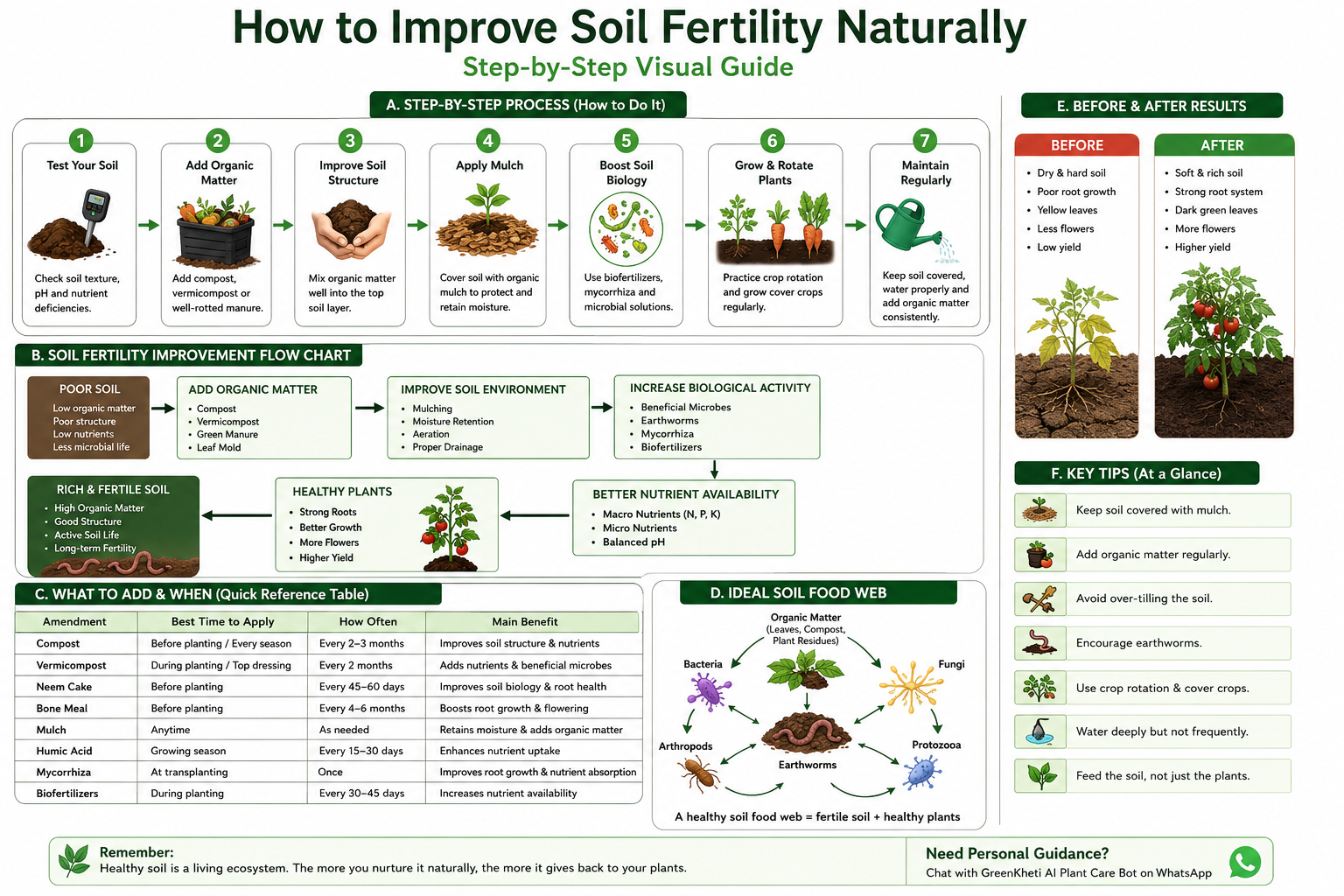
Step 1: Test Your Soil
Start by checking your soil's texture, drainage, pH, and visible nutrient deficiencies. Understanding your soil helps you choose the right amendments instead of applying unnecessary products.
Step 2: Add Organic Matter
Mix compost, vermicompost, or well-rotted manure into the topsoil. Organic matter improves soil structure, increases nutrient availability, and supports beneficial microorganisms.
Step 3: Improve Soil Structure
Loosen compacted soil and incorporate organic matter evenly throughout the root zone. Well-structured soil improves aeration, drainage, and root penetration.
Step 4: Apply Mulch
Cover the soil with organic mulch such as dry leaves, straw, or wood chips. Mulching conserves moisture, suppresses weeds, protects soil organisms, and gradually adds organic matter.
Step 5: Boost Soil Biology
Encourage beneficial microorganisms by applying biofertilizers, mycorrhiza, compost, and other microbial solutions. Healthy soil biology naturally improves nutrient cycling.
Step 6: Grow and Rotate Plants
Practice crop rotation and grow cover crops regularly. These techniques reduce nutrient depletion, improve soil structure, and naturally replenish essential nutrients.
Step 7: Maintain Soil Regularly
Healthy soil requires ongoing care. Keep the soil covered, water appropriately, add organic matter consistently, and monitor plant health throughout the growing season.
Quick Summary
Test Soil → Add Organic Matter → Improve Soil Structure → Apply Mulch → Boost Soil Biology → Grow & Rotate Plants → Maintain Regularly
15 Proven Natural Ways to Improve Soil Fertility
Improving soil fertility naturally is a long-term investment rather than a quick fix. The goal is to build living soil that continuously supplies nutrients, retains moisture, supports beneficial microorganisms, and encourages healthy root development. The following methods work together to create sustainable soil fertility for vegetables, flowers, fruit trees, lawns, and container gardens.
1. Add Compost Regularly
Compost is one of the most effective natural soil amendments because it improves both soil fertility and soil structure. Unlike synthetic fertilizers that mainly provide nutrients, compost feeds beneficial microorganisms, increases organic matter, improves moisture retention, and gradually releases essential plant nutrients.
Well-made compost contains decomposed kitchen waste, dry leaves, grass clippings, garden waste, and other organic materials. As microorganisms continue breaking it down, nutrients become slowly available to plant roots over several months.
Benefits of Compost
- Improves soil structure.
- Increases beneficial microbes.
- Improves moisture retention.
- Enhances nutrient availability.
- Reduces soil compaction.
- Supports earthworm populations.
Recommended frequency: Add compost every 2–3 months or before planting each growing season.
2. Use Vermicompost
Vermicompost is produced by earthworms digesting organic matter. It contains plant-available nutrients, beneficial bacteria, enzymes, and natural growth-promoting substances. Compared to ordinary compost, vermicompost generally contains a higher concentration of readily available nutrients.
Because it improves microbial activity without burning roots, vermicompost is suitable for seedlings, flowering plants, vegetables, herbs, and indoor plants.
Tip: Mix vermicompost into the top few centimeters of soil instead of leaving it on the surface.
3. Apply Neem Cake
Neem cake is an organic soil amendment made from neem seeds after oil extraction. Besides supplying nutrients, it supports healthy soil biology and helps improve the root environment.
Its slow nutrient release makes it an excellent addition to vegetable gardens, flowering plants, fruit trees, and potted plants.
| Benefit | How It Helps |
|---|---|
| Organic Nutrition | Gradual nutrient release. |
| Root Health | Supports healthy root development. |
| Microbial Activity | Encourages beneficial microorganisms. |
| Long-lasting | Works for several weeks. |
4. Protect Soil with Organic Mulch
Mulching covers the soil surface using dry leaves, straw, grass clippings, bark, or compost. It protects soil from direct sunlight, reduces evaporation, suppresses weeds, and gradually adds organic matter as the mulch decomposes.
Mulch also protects beneficial microorganisms by maintaining a more stable soil temperature throughout the year.
- Reduces water evaporation.
- Improves organic matter.
- Protects topsoil.
- Reduces erosion.
- Encourages earthworms.
- Suppresses weeds.
5. Grow Cover Crops
Cover crops are grown primarily to improve the soil rather than for harvest. Legumes such as cowpea, clover, and sunn hemp naturally fix atmospheric nitrogen through beneficial bacteria living in their root nodules.
When incorporated into the soil, cover crops increase organic matter, reduce erosion, improve soil structure, and support microbial diversity.
6. Practice Crop Rotation
Growing the same crop repeatedly in one location gradually depletes specific nutrients and encourages pest buildup. Rotating crops helps balance nutrient use while naturally breaking pest and disease cycles.
| Year | Crop Group |
|---|---|
| Year 1 | Leafy Vegetables |
| Year 2 | Fruit Vegetables |
| Year 3 | Root Crops |
| Year 4 | Legumes |
7. Use Green Manure
Green manure crops are grown specifically to be incorporated back into the soil while still green. As they decompose, they enrich the soil with organic matter and nutrients while improving microbial activity.
Popular green manure crops include sunn hemp, dhaincha, cowpea, and sesbania.
8. Improve Root Growth with Bone Meal
Bone meal is a slow-release organic fertilizer rich in phosphorus and calcium. It supports root development, flowering, and fruit production while contributing to long-term soil fertility.
Because nutrients are released gradually, bone meal remains effective for several months after application.
9. Apply Seaweed Extract
Seaweed extract contains naturally occurring plant growth compounds, trace minerals, amino acids, and carbohydrates that improve plant resilience and stimulate beneficial microbial activity.
Although seaweed extract is not a complete fertilizer, it complements other organic amendments by improving nutrient utilization and reducing plant stress.
10. Improve Nutrient Uptake with Humic Acid
Humic acid improves nutrient availability by increasing the soil's ability to retain minerals and moisture. It also enhances root development, microbial activity, and overall soil structure.
Humic acid does not replace fertilizers—it helps plants use existing nutrients more efficiently.
11. Improve Soil Biology with Mycorrhiza
Mycorrhiza are beneficial fungi that form a natural partnership with plant roots. These microscopic fungi extend far beyond the root zone through tiny fungal threads called hyphae, allowing plants to access water and nutrients that roots alone cannot reach.
Healthy mycorrhizal networks significantly improve phosphorus uptake, micronutrient absorption, drought tolerance, and overall plant vigor. Once established, they continue supporting plants throughout their life cycle.
Benefits of Mycorrhiza
- Expands the effective root system.
- Improves phosphorus absorption.
- Increases drought resistance.
- Supports healthier root growth.
- Improves soil biological activity.
- Enhances nutrient efficiency.
Best time to apply: During planting or transplanting when roots are directly exposed to the soil.
12. Correct Magnesium Deficiency with Epsom Salt
Magnesium is the central element of chlorophyll, making it essential for photosynthesis. If soil lacks magnesium, plants may develop yellow leaves with green veins, reduced growth, and lower yields.
Epsom salt (magnesium sulfate) provides magnesium and sulfur but should only be used when a deficiency is confirmed or likely. Routine application without need may disturb nutrient balance.
Use only when necessary: Epsom salt is a corrective amendment, not a complete fertilizer.
13. Encourage Beneficial Microorganisms with Biofertilizers
Biofertilizers contain living microorganisms that naturally increase nutrient availability in the soil. Unlike chemical fertilizers, they do not directly supply large amounts of nutrients. Instead, they help convert unavailable nutrients into forms plants can absorb.
Different biofertilizers perform different functions. Nitrogen-fixing bacteria convert atmospheric nitrogen into plant-available forms, while phosphate-solubilizing bacteria release phosphorus already present in the soil.
| Biofertilizer | Main Function |
|---|---|
| Azotobacter | Nitrogen fixation |
| Azospirillum | Improves root growth |
| Rhizobium | Supports legumes |
| PSB | Solubilizes phosphorus |
| Potassium Mobilizing Bacteria | Improves potassium availability |
14. Increase Organic Matter Every Year
Organic matter acts as the engine of fertile soil. It improves nutrient retention, supports microbial life, enhances soil structure, and increases water-holding capacity. Even small annual increases in organic matter can produce noticeable improvements in long-term soil productivity.
Sources of organic matter include compost, vermicompost, leaf mold, crop residues, aged manure, green manure, and decomposed mulch.
Aim to increase soil organic matter gradually instead of making one large application.
15. Encourage Earthworms Naturally
Earthworms are often called "nature's soil engineers" because they continuously improve soil structure while feeding on decomposing organic material. Their tunnels improve aeration, drainage, and root penetration, while their castings contain readily available nutrients and beneficial microorganisms.
Healthy earthworm populations are among the best indicators of fertile, biologically active soil.
- Add compost regularly.
- Avoid excessive tillage.
- Keep soil moist but not waterlogged.
- Maintain mulch throughout the year.
- Reduce unnecessary chemical inputs.
Comparison of Natural Soil Fertility Improvement Methods
| Method | Improves Nutrients | Improves Soil Structure | Supports Microbes | Long-Term Benefit |
|---|---|---|---|---|
| Compost | ★★★★★ | ★★★★★ | ★★★★★ | ★★★★★ |
| Vermicompost | ★★★★★ | ★★★★☆ | ★★★★★ | ★★★★★ |
| Neem Cake | ★★★★☆ | ★★★☆☆ | ★★★★★ | ★★★★☆ |
| Mulching | ★★★☆☆ | ★★★★★ | ★★★★★ | ★★★★★ |
| Cover Crops | ★★★★★ | ★★★★★ | ★★★★★ | ★★★★★ |
| Green Manure | ★★★★★ | ★★★★★ | ★★★★★ | ★★★★★ |
| Bone Meal | ★★★★☆ | ★★☆☆☆ | ★★★☆☆ | ★★★★☆ |
| Seaweed Extract | ★★★☆☆ | ★★☆☆☆ | ★★★★☆ | ★★★☆☆ |
| Humic Acid | ★★★★☆ | ★★★★★ | ★★★★★ | ★★★★★ |
| Mycorrhiza | ★★★★★ | ★★★☆☆ | ★★★★★ | ★★★★★ |
| Biofertilizers | ★★★★☆ | ★★★☆☆ | ★★★★★ | ★★★★★ |
10 Mistakes That Reduce Soil Fertility
- Leaving soil bare throughout the year.
- Adding only chemical fertilizers without organic matter.
- Removing all fallen leaves instead of composting them.
- Growing the same crop repeatedly.
- Overwatering or poor drainage.
- Excessive tillage that destroys soil structure.
- Ignoring soil pH.
- Burning garden waste instead of recycling it into compost.
- Applying undecomposed organic matter directly around plants.
- Expecting immediate improvements instead of building soil gradually.
How to Improve Soil Fertility for Different Types of Plants
Different plants consume nutrients at different rates. Heavy-feeding vegetables require nutrient-rich soil throughout the growing season, while many indoor plants and succulents thrive in moderately fertile growing media. Understanding these differences helps you improve soil naturally without over-amending or wasting resources.
| Plant Type | Best Natural Soil Improvement | Recommended Frequency |
|---|---|---|
| Vegetables | Compost + Vermicompost + Mulch | Every Season |
| Flowering Plants | Compost + Bone Meal + Neem Cake | Every 2–3 Months |
| Fruit Trees | Compost + Mulch + Humic Acid | Twice Yearly |
| Indoor Plants | Vermicompost + Compost | Every 3 Months |
| Succulents | Small Amount of Compost | Twice Yearly |
| Lawns | Compost Top Dressing | Twice Yearly |
How Long Does It Take to Improve Soil Fertility Naturally?
Natural soil improvement is a gradual biological process. While some amendments begin working within days, building fertile, biologically active soil generally takes several months or even years. The timeline depends on soil condition, climate, organic matter added, and management practices.
| Time | Expected Improvement |
|---|---|
| 1 Week | Improved soil moisture after mulching. |
| 2–4 Weeks | Increased microbial activity begins. |
| 2–3 Months | Noticeable improvement in plant growth. |
| 6 Months | Higher organic matter and improved soil structure. |
| 1 Year | Healthier soil ecosystem with better nutrient cycling. |
| 2+ Years | Long-term sustainable soil fertility. |
Common Nutrient Deficiencies and Natural Solutions
Plants require a balanced supply of macro and micronutrients. The table below lists common deficiencies and natural amendments that may help improve nutrient availability over time.
| Nutrient | Common Symptoms | Natural Source |
|---|---|---|
| Nitrogen | Yellow older leaves | Compost, Vermicompost, Legumes |
| Phosphorus | Poor root growth | Bone Meal |
| Potassium | Weak flowering | Compost, Wood Ash (where suitable) |
| Calcium | Leaf deformation | Eggshell Compost |
| Magnesium | Yellow leaves with green veins | Epsom Salt (when required) |
| Sulfur | Pale young leaves | Organic Matter |
| Iron | Interveinal chlorosis | Well-aged Compost |
Why Soil Microorganisms Are the Real Builders of Fertile Soil
Healthy soil contains billions of bacteria, fungi, protozoa, nematodes, insects, and earthworms working together in what scientists call the soil food web. These organisms decompose organic matter, recycle nutrients, improve soil structure, and protect plant roots from environmental stress.
Without this biological activity, even nutrient-rich soil becomes less productive because many nutrients remain unavailable to plant roots. Feeding soil organisms through compost, mulch, and organic matter is one of the most effective long-term strategies for naturally improving soil fertility.
Remember: Healthy soil microorganisms continuously produce plant-available nutrients, reducing the need for repeated fertilizer applications.
Monthly Soil Fertility Checklist
- ✅ Add compost when needed.
- ✅ Keep soil covered with mulch.
- ✅ Avoid compacting wet soil.
- ✅ Observe earthworm activity.
- ✅ Rotate vegetable crops.
- ✅ Remove weeds before they set seed.
- ✅ Check drainage after heavy rain.
- ✅ Water deeply rather than frequently.
- ✅ Inspect plants for nutrient deficiency symptoms.
- ✅ Add organic matter at least once every season.
GreenKheti Expert Tips for Naturally Fertile Soil
- Focus on feeding the soil instead of only feeding plants.
- Increase organic matter gradually every year.
- Never leave soil exposed for long periods.
- Use compost as the foundation of every garden.
- Encourage earthworms rather than disturbing them.
- Reduce excessive digging and tilling.
- Use biofertilizers to improve nutrient cycling naturally.
- Choose slow, sustainable soil improvement instead of quick fixes.
- Healthy soil today means healthier plants for many growing seasons.
Natural Products That Help Improve Soil Fertility
Building fertile soil requires consistent care rather than a one-time fertilizer application. Organic soil amendments, beneficial microbes, and natural soil conditioners can gradually improve soil structure, nutrient availability, microbial activity, and root development.
| Product | Primary Benefit | Best Time to Use | Learn More |
|---|---|---|---|
| Neem Cake Powder | Improves soil biology and organic fertility | Before planting or every 45–60 days | Website | Amazon |
| Power Meal Bone Meal | Supports root development and flowering | Before planting | Website | Amazon |
| Seaweed Extract | Improves plant vigor and stress tolerance | Growing season | Website | Amazon |
| Humic Acid | Enhances nutrient uptake and soil structure | Every 15–30 days | Website | Amazon |
| MycoMagic Mycorrhiza | Supports beneficial fungi and root growth | During planting | Website | Amazon |
| Epsom Salt | Corrects magnesium deficiency | Only when required | Website | Amazon |
Not Sure How to Improve Your Soil Naturally?
Every garden is different. Soil texture, nutrient levels, drainage, sunlight, and plant type all influence the best way to improve soil fertility. Instead of guessing, you can receive personalized recommendations based on your plants.
Frequently Asked Questions
What is the fastest natural way to improve soil fertility?
Adding mature compost is one of the quickest and most effective natural methods because it improves soil structure, microbial activity, and nutrient availability simultaneously.
How long does it take to improve soil fertility naturally?
Small improvements can appear within a few weeks, but building rich, biologically active soil generally takes several months to a few years depending on management practices.
Can compost replace chemical fertilizers?
Compost improves soil health and supplies nutrients gradually. Heavy-feeding crops may still require additional fertilizers depending on soil conditions and crop requirements.
Does mulching improve soil fertility?
Yes. Organic mulch decomposes over time, adding organic matter while conserving moisture and protecting beneficial soil organisms.
Is vermicompost better than ordinary compost?
Both are valuable. Vermicompost generally contains more readily available nutrients and beneficial microorganisms, while compost contributes larger amounts of organic matter.
Why are earthworms important for fertile soil?
Earthworms improve aeration, drainage, nutrient cycling, and soil structure while producing nutrient-rich castings.
How often should organic matter be added?
Adding compost or other organic matter at least once every growing season helps maintain long-term soil fertility.
Can poor soil become fertile again?
Yes. With regular additions of compost, mulch, cover crops, and proper soil management, most soils can gradually regain fertility.
Do beneficial microbes really improve plant growth?
Yes. Beneficial bacteria and fungi help convert nutrients into forms plants can absorb while supporting healthy root systems.
Should I improve soil before planting?
Yes. Incorporating organic matter before planting creates a healthier environment for root establishment and nutrient uptake.
Can I improve soil fertility without chemicals?
Yes. Compost, vermicompost, mulch, crop rotation, green manure, biofertilizers, and organic amendments naturally improve soil fertility over time.
What causes soil to lose fertility?
Continuous cropping, erosion, nutrient leaching, low organic matter, excessive tillage, and poor soil management gradually reduce fertility.
Does soil pH affect fertility?
Yes. Soil pH influences how easily plants can absorb nutrients. Even nutrient-rich soil may perform poorly if the pH is unsuitable.
Is humic acid a fertilizer?
No. Humic acid is a soil conditioner that improves nutrient availability and soil structure rather than supplying large amounts of nutrients itself.
What is the most important factor for fertile soil?
Maintaining high organic matter and an active community of beneficial soil microorganisms is one of the most important foundations of naturally fertile soil.
Conclusion
Improving soil fertility naturally is one of the most valuable investments you can make for your garden. Healthy soil supports stronger roots, better nutrient absorption, improved water retention, higher microbial activity, and long-term plant productivity. Instead of depending solely on quick nutrient applications, focus on building living soil through compost, organic matter, mulch, beneficial microbes, crop rotation, and sustainable gardening practices.
Remember that soil fertility develops gradually. Every layer of compost, every mulch application, and every beneficial microorganism contributes to a healthier soil ecosystem that will continue supporting plants for years. By feeding the soil first, you create an environment where plants naturally grow stronger, flower better, and produce healthier harvests.
Continue Reading
References
