

Gardening Tips
How Often Should You Fertilize Plants? Best Guide
Jul
Learn how often to fertilize indoor plants, vegetables, flowering plants, fruit trees, lawns, and potted plants. Discover the ideal fertilizing schedule based on plant type, season, fertilizer type, and growth stage.
AI Quick Answer
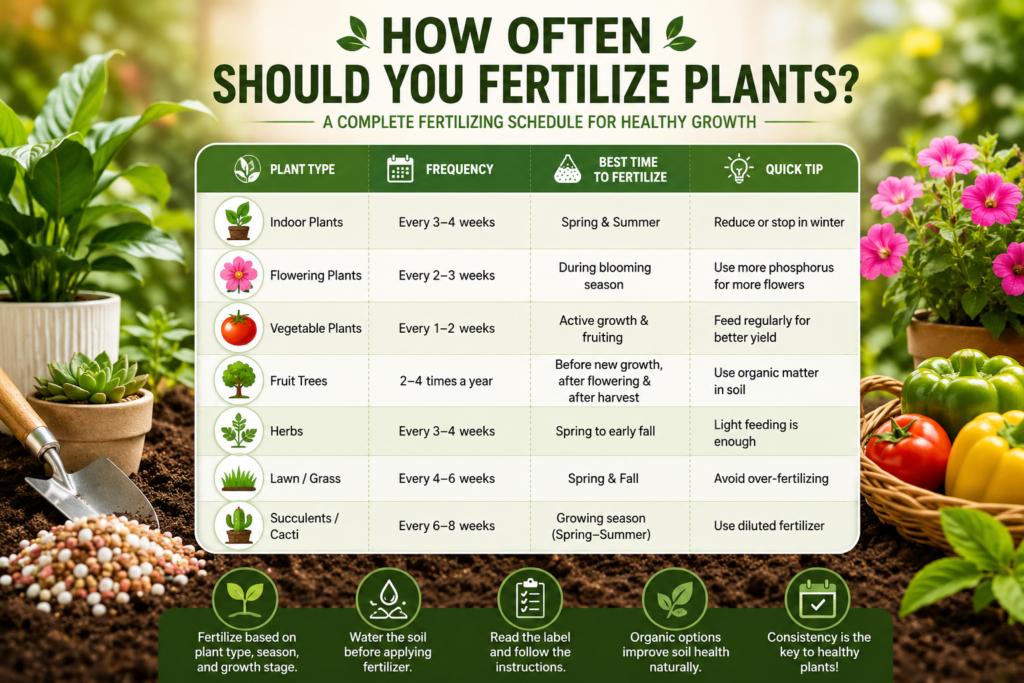
How often you should fertilize plants depends on the plant species, growth stage, growing season, soil condition, and fertilizer type. Fast-growing vegetables and flowering plants often need fertilizer every 1–2 weeks when using liquid fertilizers, while slow-release granular fertilizers may only need application every 2–3 months. Indoor plants usually require less frequent feeding than outdoor plants. Instead of following one universal schedule, match fertilizer frequency to the plant’s growth cycle for healthier roots, stronger growth, and better flowering.
Key Takeaways
- There is no single fertilizing schedule that works for every plant.
- Growth stage is more important than plant age.
- Most plants need more nutrients during active growth.
- Over-fertilizing is often more harmful than under-fertilizing.
- Liquid fertilizers require more frequent application than granular fertilizers.
- Plants generally require less fertilizer during winter dormancy.
- Always read fertilizer labels before application.
Table of Contents
How Often Should You Fertilize Plants?
One of the most common gardening questions is not which fertilizer to use, but how often should you fertilize plants? Applying fertilizer too frequently may damage roots, reduce flowering, waste nutrients, and increase salt buildup in the soil. Fertilizing too little can result in slow growth, yellow leaves, weak stems, poor flowering, and lower fruit production.
Unlike watering, fertilizing does not follow a universal weekly schedule. Every plant absorbs nutrients at a different rate depending on its species, age, growth stage, climate, soil quality, sunlight, and whether it is grown in the ground or in a container.
For example, a tomato plant growing rapidly during summer requires nutrients much more frequently than a snake plant growing indoors during winter. Similarly, flowering plants demand additional phosphorus and potassium before blooming, while leafy vegetables consume more nitrogen during vegetative growth.
Understanding these natural growth patterns helps gardeners avoid unnecessary fertilizer applications while providing plants with nutrients exactly when they need them most.
Why Fertilizer Timing Matters More Than Fertilizer Quantity
Plants only absorb nutrients efficiently when they are actively growing. During periods of dormancy or slow growth, fertilizer often remains unused in the soil, increasing the risk of nutrient loss through leaching or salt accumulation.
Applying fertilizer at the correct time improves nutrient use efficiency, reduces waste, and supports stronger root development. Proper timing also encourages healthier flowering, fruit production, and overall plant vigor.
| Correct Timing | Wrong Timing |
|---|---|
| Healthy root growth | Nutrient wastage |
| Better flowering | Root burn |
| Improved fruit production | Salt accumulation |
| Efficient nutrient uptake | Poor nutrient absorption |
| Lower fertilizer cost | Unnecessary repeat applications |
What Determines How Often Plants Need Fertilizer?
Several factors influence how frequently plants require fertilizer. Understanding these variables helps create a fertilizing schedule that matches your garden rather than relying on fixed monthly routines.
1. Plant Species
Fast-growing vegetables consume nutrients rapidly, while slow-growing ornamentals and succulents require much less frequent feeding.
2. Growth Stage
Seedlings, vegetative plants, flowering plants, and fruiting plants all have different nutritional demands throughout their life cycle.
3. Fertilizer Type
Liquid fertilizers are absorbed quickly and usually require more frequent applications than slow-release granular fertilizers.
4. Soil Type
Sandy soils lose nutrients faster than clay soils, meaning fertilizer may need to be applied more frequently.
5. Climate
Heavy rainfall, high temperatures, and frequent irrigation can wash nutrients away more quickly, increasing fertilizer requirements.
6. Pot or Ground Planting
Container plants exhaust nutrients much faster because they have a limited amount of growing media compared to plants growing directly in the ground.
Understanding the Plant Growth Cycle Before Fertilizing
Plants do not require the same amount of nutrients throughout the year. Nutrient demand changes as plants transition through different stages of growth. Applying fertilizer according to these stages is more effective than following a fixed calendar schedule.
| Growth Stage | Nutrient Requirement | Fertilizing Frequency |
|---|---|---|
| Seed Germination | Very Low | Usually not required |
| Seedling | Low | Light feeding |
| Vegetative Growth | High | Regular fertilization |
| Flowering | High | Increase phosphorus and potassium |
| Fruiting | Moderate to High | Balanced nutrition |
| Dormancy | Minimal | Reduce or stop fertilizing |
General Fertilizing Frequency Guide
| Fertilizer Type | Typical Frequency |
|---|---|
| Liquid Fertilizer | Every 1–2 weeks |
| Water-Soluble Fertilizer | Every 7–14 days |
| Granular Fertilizer | Every 6–8 weeks |
| Slow-Release Fertilizer | Every 2–4 months |
| Organic Compost | Every 2–3 months |
| Bone Meal | Every 3–4 months |
| Neem Cake | Every 45–60 days |
How Often Should You Fertilize Indoor Plants?
Indoor plants generally require less fertilizer than outdoor plants because they grow more slowly and receive less sunlight. Since they grow in containers with a limited amount of potting mix, nutrients are gradually depleted over time and must be replenished through regular fertilization.
During spring and summer, most indoor plants actively produce new leaves and roots. This is the ideal period to fertilize them. During autumn and winter, plant growth naturally slows, so fertilizer applications should also be reduced.
| Indoor Plant | Recommended Frequency | Best Time |
|---|---|---|
| Money Plant | Every 2–4 weeks | Spring & Summer |
| Snake Plant | Every 6–8 weeks | Growing Season |
| Peace Lily | Every 3–4 weeks | Before Flowering |
| Spider Plant | Every 3–4 weeks | Active Growth |
| ZZ Plant | Every 6–8 weeks | Spring & Summer |
| Aloe Vera | Every 2–3 months | Growing Season |
How Often Should You Fertilize Outdoor Plants?
Outdoor plants are exposed to rainfall, irrigation, wind, and changing temperatures, all of which affect nutrient availability. Heavy rain can wash nutrients deeper into the soil, while frequent watering may increase nutrient loss from containers and raised beds.
Instead of fertilizing on a fixed monthly schedule, monitor plant growth, flowering, and leaf color. Healthy plants growing vigorously usually require less additional fertilizer than stressed or nutrient-deficient plants.
Tip:Healthy soil enriched with compost often reduces the need for frequent fertilizer applications.
How Often Should You Fertilize Vegetable Plants?
Vegetables are among the highest nutrient-consuming plants because they produce leaves, flowers, and edible fruits within a short growing season. Fast-growing crops benefit from regular nutrient replenishment throughout their life cycle.
| Vegetable | Frequency | Notes |
|---|---|---|
| Tomato | Every 10–14 days | Increase potassium during fruiting. |
| Chilli | Every 2 weeks | Balanced nutrition throughout growth. |
| Brinjal | Every 2 weeks | Feed during flowering and fruiting. |
| Cucumber | Every 10–14 days | Requires continuous nutrients. |
| Spinach | Every 3 weeks | Focus on nitrogen-rich nutrition. |
| Okra | Every 2–3 weeks | Balanced fertilizer works well. |
How Often Should You Fertilize Flowering Plants?
Flowering plants require nutrients before buds appear and throughout the blooming period. Continuous flowering species consume phosphorus and potassium rapidly, making regular feeding important for healthy blooms.
| Flower Plant | Recommended Frequency | Priority Nutrients |
|---|---|---|
| Rose | Every 2 weeks | Balanced NPK |
| Hibiscus | Every 10–14 days | Potassium |
| Marigold | Every 2 weeks | Balanced Nutrition |
| Jasmine | Every 3 weeks | Phosphorus |
| Bougainvillea | Monthly | Low Nitrogen |
How Often Should You Fertilize Fruit Trees?
Fruit trees require seasonal fertilization rather than weekly feeding. Most fruit trees benefit from fertilization before new growth begins, during flowering, and after harvest depending on the species.
| Fruit Plant | Recommended Frequency | Best Season |
|---|---|---|
| Mango | 2–3 times per year | Before flowering |
| Lemon | Every 6–8 weeks | Growing Season |
| Guava | Every 2 months | Spring & Monsoon |
| Pomegranate | Every 6 weeks | Flowering Stage |
| Papaya | Monthly | Throughout growth |
How Often Should You Fertilize Herbs?
Most culinary herbs naturally grow well in moderately fertile soils. Over-fertilizing herbs often results in lush leaves with reduced aroma and flavor.
- Basil — Every 3–4 weeks
- Mint — Every month
- Coriander — Light feeding every 4 weeks
- Parsley — Every month
- Tulsi (Holy Basil) — Every 3–4 weeks
How Often Should You Fertilize Succulents and Cacti?
Succulents and cacti naturally grow in nutrient-poor environments. Frequent fertilization can lead to weak growth, stretched stems, and reduced drought tolerance.
Recommended Schedule:Feed once every 2–3 months during spring and summer. Avoid fertilizing during winter dormancy.
How Often Should You Fertilize Lawns?
Lawns require regular feeding because grass is repeatedly cut, removing nutrients with every mowing. Fertilizer requirements vary depending on grass species, rainfall, irrigation, and soil fertility.
| Season | Recommended Frequency |
|---|---|
| Spring | Every 6–8 weeks |
| Summer | Every 8 weeks |
| Monsoon | Only if needed |
| Winter | Minimal feeding |
Seasonal Fertilizing Calendar
| Season | Fertilizing Recommendation |
|---|---|
| Spring | Start regular fertilization as plants begin active growth. |
| Summer | Continue feeding fast-growing plants. |
| Monsoon | Reduce applications during prolonged heavy rainfall. |
| Autumn | Gradually decrease fertilizer frequency. |
| Winter | Feed only actively growing plants. |
How Fertilizer Type Affects Application Frequency
Not all fertilizers release nutrients at the same speed. Some provide immediate nutrition, while others continue feeding plants for several weeks or even months. Understanding how each fertilizer behaves helps prevent over-fertilizing and ensures nutrients are available when plants need them most.
| Fertilizer Type | Typical Frequency | Best For |
|---|---|---|
| Liquid Fertilizer | Every 1–2 weeks | Rapid nutrient uptake |
| Water Soluble Fertilizer | Every 7–14 days | Fast-growing plants |
| Granular Fertilizer | Every 6–8 weeks | Routine feeding |
| Slow Release Fertilizer | Every 2–4 months | Long-term nutrition |
| Organic Compost | Every 2–3 months | Soil improvement |
| Bone Meal | Every 3–4 months | Root development |
| Neem Cake | Every 45–60 days | Healthy soil ecosystem |
| Seaweed Extract | Every 10–15 days | Stress recovery |
| Humic Acid | Every 15–30 days | Nutrient uptake |
| Mycorrhiza | Usually once during planting | Root establishment |
Container Plants vs Ground Plants: Who Needs More Frequent Fertilizing?
Plants growing in containers have access to a much smaller volume of soil than plants growing in garden beds. Watering gradually washes nutrients out of pots, making container plants more dependent on regular fertilization.
| Factor | Container Plants | Ground Plants |
|---|---|---|
| Available Soil | Limited | Large Root Zone |
| Nutrient Loss | Higher | Lower |
| Watering Frequency | More Frequent | Less Frequent |
| Fertilizing Frequency | Higher | Lower |
| Salt Build-up Risk | Higher | Lower |
Newly Planted vs Established Plants
Freshly planted seedlings and transplants require gentle nutrition until their root systems become established. Mature plants usually benefit from regular fertilization based on their growth stage and nutrient demand.
| Plant Stage | Fertilizer Recommendation |
|---|---|
| New Seedlings | Minimal feeding |
| Young Plants | Light fertilizer every 2–3 weeks |
| Mature Plants | Regular feeding according to crop |
| Flowering Plants | Increase phosphorus and potassium |
| Dormant Plants | Reduce or stop fertilizing |
10 Signs You Are Fertilizing Too Often
- Brown leaf tips.
- Leaf burn around the edges.
- White salt deposits on soil.
- Wilting despite moist soil.
- Weak roots.
- Poor flowering.
- Leaf drop.
- Slow growth after fertilizing.
- Soft, weak stems.
- Excessive leafy growth with fewer flowers or fruits.
10 Signs Your Plants Need Fertilizer
- Yellow older leaves.
- Pale green foliage.
- Slow growth.
- Small leaves.
- Poor flowering.
- Low fruit production.
- Weak stems.
- Premature leaf drop.
- Delayed maturity.
- Reduced overall plant vigor.
How Often Should You Fertilize Plants? Decision Guide
- Growing vegetables? → Feed every 1–2 weeks during active growth.
- Growing flowering plants? → Feed every 2–3 weeks during blooming.
- Growing indoor plants? → Feed every 3–6 weeks in spring and summer.
- Using slow-release fertilizer? → Reapply every 2–4 months.
- Using liquid fertilizer? → Apply every 7–14 days.
- Plant dormant? → Reduce or stop fertilizing.
- Not sure? → Chat with the GreenKheti AI Plant Care WhatsApp Bot .
20 Common Fertilizing Mistakes Gardeners Make
- Applying fertilizer on a fixed calendar without observing plants.
- Using too much fertilizer.
- Ignoring fertilizer labels.
- Fertilizing dry soil.
- Applying fertilizer during extreme heat.
- Feeding dormant plants.
- Using the same fertilizer for every plant.
- Not watering after granular fertilizer.
- Overusing nitrogen.
- Ignoring soil health.
- Applying fertilizer before heavy rain.
- Mixing incompatible fertilizers.
- Ignoring micronutrients.
- Using expired fertilizer.
- Fertilizing stressed plants.
- Not adjusting feeding frequency for containers.
- Overlooking soil pH.
- Expecting immediate results from slow-release fertilizers.
- Applying fertilizer too close to plant stems.
- Skipping regular plant observations.
GreenKheti Expert Tips
- Feed plants according to their growth stage rather than a fixed monthly schedule.
- Healthy soil reduces the need for frequent fertilization.
- Observe leaves, flowers, and new growth before deciding to fertilize.
- Always water after applying granular fertilizers.
- Apply liquid fertilizers during the cooler hours of the day.
- Reduce fertilization during winter or dormancy.
- Combine compost with balanced fertilizers for long-term soil health.
- When unsure, fertilize less rather than more—plants recover from mild deficiencies more easily than fertilizer burn.
Month-by-Month Plant Fertilizing Calendar (India)
India experiences diverse climatic conditions throughout the year. Instead of fertilizing every month blindly, adjust your schedule according to plant growth, rainfall, and seasonal temperature changes.
| Month | Recommendation | Priority |
|---|---|---|
| January | Feed only actively growing winter vegetables and flowers. | Low |
| February | Prepare plants for spring growth. | Moderate |
| March | Begin regular fertilizing schedule. | High |
| April | Support rapid vegetative growth. | High |
| May | Maintain nutrition during hot weather. | High |
| June | Reduce feeding before heavy rainfall. | Moderate |
| July | Monitor nutrient leaching during monsoon. | Moderate |
| August | Continue balanced feeding if plants are actively growing. | Moderate |
| September | Increase feeding before flowering season. | High |
| October | Excellent month for vegetables and flowers. | High |
| November | Maintain moderate fertilization. | Moderate |
| December | Reduce feeding for dormant plants. | Low |
How Often Should You Fertilize Different Plants?
The following table provides a quick reference for some of the most popular garden, indoor, vegetable, fruit, and flowering plants grown in India.
| Plant | Frequency | Growing Season |
|---|---|---|
| Tomato | Every 10–14 days | Summer |
| Chilli | Every 2 weeks | Summer |
| Brinjal | Every 2 weeks | Summer |
| Okra | Every 2–3 weeks | Summer |
| Spinach | Every 3 weeks | Winter |
| Cucumber | Every 10–14 days | Summer |
| Rose | Every 2 weeks | Year-round |
| Hibiscus | Every 10–14 days | Summer |
| Marigold | Every 2 weeks | Winter |
| Jasmine | Every 3 weeks | Summer |
| Bougainvillea | Monthly | Summer |
| Money Plant | Every 3–4 weeks | Spring |
| Snake Plant | Every 6–8 weeks | Summer |
| Peace Lily | Every 3 weeks | Spring |
| Spider Plant | Monthly | Spring |
| ZZ Plant | Every 6 weeks | Summer |
| Aloe Vera | Every 2–3 months | Summer |
| Tulsi | Every 3 weeks | Year-round |
| Mint | Monthly | Summer |
| Coriander | Monthly | Winter |
| Basil | Every 3 weeks | Summer |
| Lemon | Every 6 weeks | Year-round |
| Mango | 2–3 times yearly | Seasonal |
| Guava | Every 2 months | Seasonal |
| Papaya | Monthly | Year-round |
| Pomegranate | Every 6 weeks | Seasonal |
| Banana | Every month | Year-round |
| Coconut | Twice yearly | Seasonal |
| Areca Palm | Every 2 months | Summer |
| Lawn Grass | Every 6–8 weeks | Growing season |
Fertilizing Frequency Based on Climate
Climate affects nutrient availability, microbial activity, and plant growth. Fertilizer schedules should be adjusted according to local weather rather than following a fixed calendar.
| Climate | Recommendation |
|---|---|
| Hot & Dry | Smaller, more frequent fertilizer applications with regular watering. |
| Monsoon | Reduce fertilizer frequency because heavy rain can wash nutrients away. |
| Cool Winter | Reduce feeding unless plants are actively growing. |
| Tropical | Maintain a regular fertilizing schedule throughout the growing season. |
| Humid Regions | Monitor nutrient leaching and fungal diseases before fertilizing. |
Pot Size vs Fertilizing Frequency
Smaller pots lose nutrients more quickly because they contain less growing media. Larger containers retain nutrients longer and generally require less frequent fertilization.
| Pot Size | Recommended Feeding |
|---|---|
| 4–6 inch | Every 2 weeks |
| 8–10 inch | Every 3 weeks |
| 12–14 inch | Every 4 weeks |
| 16–20 inch | Every 5–6 weeks |
| 24 inch & Larger | Every 6–8 weeks |
Quick Fertilizer Frequency Cheat Sheet
- 🌱 Seedlings → Very light feeding after true leaves appear.
- 🥬 Vegetables → Every 1–2 weeks during active growth.
- 🌸 Flowering Plants → Every 2 weeks while blooming.
- 🍅 Fruiting Plants → Every 10–14 days.
- 🪴 Indoor Plants → Every 3–6 weeks.
- 🌵 Succulents → Every 2–3 months.
- 🌳 Fruit Trees → Every 6–8 weeks or seasonally.
- 🌾 Lawn → Every 6–8 weeks.
- 🍂 Dormant Plants → Reduce or stop fertilizing.
- 📖 Always follow the fertilizer label instructions for dosage and timing.
Real Fertilizing Schedules for Popular Plants
Every plant grows differently and therefore has different nutritional requirements. Instead of applying fertilizer on the same schedule for every plant, adjust the frequency based on its growth habit, flowering cycle, and nutrient demand.
| Plant | Recommended Frequency | Best Fertilizer Type | Important Tip |
|---|---|---|---|
| Tomato | 10–14 Days | Liquid + Granular | Increase potassium after flowering. |
| Chilli | Every 2 Weeks | Balanced NPK | Reduce nitrogen after fruiting begins. |
| Rose | Every 2 Weeks | Organic + Liquid | Feed before every flowering flush. |
| Hibiscus | 10–14 Days | Liquid | Requires regular potassium. |
| Money Plant | Monthly | Liquid | Use diluted fertilizer. |
| Snake Plant | 6–8 Weeks | Slow Release | Avoid over-fertilizing. |
| Peace Lily | 3–4 Weeks | Liquid | Feed during active growth. |
| Lemon | 6 Weeks | Granular | Apply around drip line. |
| Mango | 2–3 Times/Year | Organic | Avoid heavy feeding before harvest. |
| Aloe Vera | 2–3 Months | Low Dose Liquid | Minimal fertilizer required. |
| Tulsi | 3–4 Weeks | Organic | Light feeding is sufficient. |
| Jasmine | 3 Weeks | Flower Fertilizer | Feed before budding. |
How Often to Apply Different NPK Fertilizers
Different NPK fertilizers release nutrients differently. The fertilizer ratio affects plant growth, but the application frequency depends on whether the fertilizer is liquid, granular, or slow release.
| Fertilizer | Frequency | Common Use |
|---|---|---|
| 19-19-19 | Every 10–15 days | General plant growth |
| 20-20-20 | Every 2 weeks | Balanced nutrition |
| 10-26-26 | Every 2–3 weeks | Flowering & Fruiting |
| 13-40-13 | Before flowering | Bud initiation |
| 00-52-34 | Every 15–20 days | Flowering support |
| Urea | Only when nitrogen is needed | Leafy growth |
Pot Size and Fertilizer Frequency
Smaller pots lose nutrients much faster because watering washes minerals out of the growing media. Larger containers retain nutrients for longer periods.
| Pot Size | Recommended Feeding | Reason |
|---|---|---|
| 4–6 inch | Every 2 weeks | Limited growing media. |
| 8 inch | Every 3 weeks | Moderate nutrient storage. |
| 12 inch | Monthly | Good nutrient retention. |
| 18 inch | Every 5 weeks | Larger root zone. |
| 24 inch+ | Every 6–8 weeks | Large nutrient reserve. |
Fertilizing Myths vs Facts
| Myth | Fact |
|---|---|
| More fertilizer means faster growth. | Too much fertilizer often damages roots. |
| Indoor plants need fertilizer every week. | Most indoor plants grow slowly and require less frequent feeding. |
| All plants need the same fertilizer schedule. | Different species have different nutrient requirements. |
| Rainwater fertilizes plants. | Rain provides water, not balanced nutrients. |
| Compost alone always provides enough nutrients. | Heavy-feeding plants often require supplemental fertilization. |
| Yellow leaves always mean fertilizer deficiency. | Overwatering, pests, disease, or poor drainage can also cause yellow leaves. |
Monthly Fertilizing Checklist
- ✅ Inspect leaves for discoloration.
- ✅ Check new growth.
- ✅ Look for flower bud development.
- ✅ Monitor soil moisture before fertilizing.
- ✅ Read fertilizer label instructions.
- ✅ Apply fertilizer during cool morning or evening hours.
- ✅ Water after granular fertilizer application.
- ✅ Avoid fertilizing stressed plants.
- ✅ Record fertilizing dates in a garden journal.
- ✅ Adjust the schedule according to season and plant growth.
Why Fertilizing Too Frequently Can Harm Plants
Plant roots absorb nutrients only within certain concentration limits. When fertilizer is applied too often, dissolved salts accumulate around the root zone. This creates osmotic stress, making it difficult for roots to absorb water even when soil appears moist. Over time, excess fertilizer may lead to root burn, nutrient imbalance, leaf scorch, and reduced flowering or fruit production.
Healthy fertilization is not about applying the maximum amount of nutrients—it’s about providing the right nutrients at the right time and in the correct quantity. Following fertilizer label instructions and observing plant growth are the most reliable ways to determine when your plants truly need feeding.
Recommended GreenKheti Products
Following a proper fertilizing schedule becomes much easier when you choose products based on your plant’s growth stage instead of applying the same fertilizer throughout the year. Below are some GreenKheti products that naturally support healthy roots, foliage, flowering, fruiting, and soil fertility.
| Product | When to Use | Best For | Learn More |
|---|---|---|---|
| Neem Cake Powder | Every 45–60 days | Healthy soil and root zone | Website | Amazon |
| Seaweed Extract | Every 10–15 days | Plant growth and stress recovery | Website | Amazon |
| Humic Acid | Every 15–30 days | Root development and nutrient uptake | Website | Amazon |
| Power Meal Bone Meal | Every 3–4 months | Flowering and root development | Website | Amazon |
| MycoMagic Mycorrhiza | During planting | Root establishment | Website | Amazon |
| Epsom Salt | Every 3–4 weeks (if needed) | Magnesium deficiency | Website | Amazon |
| Flower Booster | Before flowering | Flowering plants | Website | Amazon |
| Fruit Booster | During fruit development | Fruiting plants | Website | Amazon |
Need Help Deciding When to Fertilize Your Plants?
Still unsure whether your plant needs fertilizer today, next week, or next month? The GreenKheti AI Plant Care WhatsApp Bot can help you understand your plant’s growth stage, identify nutrient deficiencies, and recommend an appropriate fertilizing schedule.
Frequently Asked Questions
How often should I fertilize most plants?
Most actively growing plants benefit from fertilization every 2–4 weeks, depending on the fertilizer type and plant species.
Can I fertilize plants every week?
Weekly fertilization is suitable only for some diluted liquid fertilizers. Always follow the manufacturer’s instructions.
Should indoor plants be fertilized in winter?
Most indoor plants require little or no fertilizer during winter unless they are actively growing.
Can too much fertilizer kill plants?
Yes. Over-fertilizing can damage roots, burn leaves, reduce flowering, and even kill plants.
How do I know when my plants need fertilizer?
Common signs include slow growth, yellow leaves, weak stems, reduced flowering, and poor fruit production.
How often should vegetables be fertilized?
Most vegetables benefit from feeding every 10–14 days during active growth and fruit production.
Should I fertilize immediately after repotting?
Usually no. Fresh potting mix often contains nutrients. Wait until plants become established before fertilizing.
Should fertilizer be applied before or after watering?
Granular fertilizers are generally followed by watering, while liquid fertilizers are diluted with water before application.
Does rainfall replace fertilizer?
No. Rain supplies water but does not replace the essential nutrients plants require for healthy growth.
Is compost enough for all plants?
Compost improves soil health, but some plants may still require additional nutrients depending on their growth stage and productivity.
Should flowering plants receive fertilizer while blooming?
Yes. Regular feeding during flowering helps support continuous blooms and healthy plant growth.
How often should fruit trees be fertilized?
Most fruit trees benefit from fertilization two to four times a year, depending on species and growing conditions.
Can I fertilize plants during hot afternoons?
It is better to fertilize during the early morning or evening to reduce plant stress.
What is the safest way to fertilize beginners’ plants?
Start with smaller doses, observe plant response, and gradually adjust the schedule instead of applying large quantities at once.
Can I use the same fertilizing schedule for every plant?
No. Different plants have different nutrient needs based on species, growth stage, season, and growing conditions.
Conclusion
The best fertilizing schedule is not based on the calendar—it’s based on your plant. Fast-growing vegetables, flowering plants, and container gardens generally require more frequent feeding than slow-growing indoor plants, succulents, or mature trees. By understanding growth stages, seasonal changes, soil conditions, and fertilizer types, you can provide nutrients only when plants truly need them.
Instead of asking, “How often should I fertilize plants?”, ask “Is my plant actively growing and showing signs that it needs nutrients?” Observing your plants and following fertilizer label instructions will help you avoid over-fertilizing while supporting healthy roots, stronger flowering, and better harvests throughout the year.
Continue Reading
- How to Read Fertilizer Labels
- Organic vs Chemical Fertilizers
- Liquid vs Granular Fertilizers
- How to Choose the Right NPK Ratio
- Best Fertilizers for Vegetable Gardens
- Best Fertilizers for Flowering Plants
- Humic Acid for Plants Guide
- Seaweed Extract for Plants Guide
- Epsom Salt for Plants Guide
- 10 Gardening Mistakes to Avoid This Season
- Growing Vegetables at Home: 10 Powerful Gardening Tips for Beginners
References
- National Institute of Agricultural Extension Management (MANAGE) – Certificate Course on Integrated Nutrient Management (CCINM)
- ICAR – Natural Resource Management: Soil & Nutrient Management Technologies
- ICAR – Indian Institute of Horticultural Research (IIHR)
- Ministry of Agriculture & Farmers Welfare, Government of India
- National Institute of Plant Health Management (NIPHM)
- Mission for Integrated Development of Horticulture (MIDH)
- National Food Security Mission (NFSM)
